Wednesday, April 6, 2011

FW: 2011 Trinity Milwaukee

I agree…


Feed: Lutheran Logomaniac
Posted on: Wednesday, April 06, 2011 1:18 PM
Author: toddpeperkorn@mac.com (Rev. Todd A. Peperkorn)
Subject: 2011 Trinity Milwaukee


2011trinitymilwaukee202011trinitymilwaukee72011trinitymilwaukee22011trinitymilwaukee32011trinitymilwaukee42011trinitymilwaukee5
2011trinitymilwaukee82011trinitymilwaukee92011trinitymilwaukee102011trinitymilwaukee162011trinitymilwaukee172011trinitymilwaukee18
2011trinitymilwaukee242011trinitymilwaukee342011trinitymilwaukee352011trinitymilwaukee372011trinitymilwaukee382011trinitymilwaukee39 - Version 3
2011trinitymilwaukee422011trinitymilwaukee432011trinitymilwaukee442011trinitymilwaukee452011trinitymilwaukee462011trinitymilwaukee47

This is one of the congregations we toured on our most recent "steeplechase". Historic Trinity Lutheran Church in Milwaukee is one of the most beautiful Lutheran Churches I've seen in this country.


View article...

FW: Beautiful “Witness-Mercy-Life Together” Lapel Pin Available Now

WMLT…


Feed: Cyberbrethren Lutheran Blog Feed
Posted on: Wednesday, April 06, 2011 1:21 PM
Author: Paul T. McCain
Subject: Beautiful "Witness-Mercy-Life Together" Lapel Pin Available Now


It's really a beautiful pin, and offers a lot of opportunity for interesting conversation about the Gospel and about the Church. We are offering it in bulk discount quantities, 75 pins for $50, or individually, for $1.75. Order it here. By the way, not to worry: this is a close up picture, it is just regular size lapel pin, one inch in diameter.


View article...

FW: What the New Pastor Needs

Call Day is coming soon…


Feed: Gottesdienst Online
Posted on: Wednesday, April 06, 2011 1:44 PM
Author: Pr. H. R.
Subject: What the New Pastor Needs


Call Day is less than a month away and the reality of leaving school and becoming responsible for the pastoral care of one of Christ's flocks is surely taking on new prominence in the minds of the candidates. Here's my short list of what the new pastor needs before he gets to his ordination day. What other tools of the trade do you recommend? What's essential and what's icing on the cake?


* A mass kit for Communion calls that includes a real chalice, paten, and crucifix. The one I've linked to from Autom is very reasonably priced and looks quite nice.


* Vestments: cassock, surplice, alb, cincture, and a complete set of chasubles and stoles. Gottesdienst has long advocated the recovery of the chasuble among Lutherans in North America and it continues to gain ground. A good way to introduce it is with a red set for ordination. You can get what you need at the usual places (CPH, Almy, Gaspard), but I'm a little biased given that my mom sews vestments and paraments (including the beautiful gold set at Fr. Petersen's parish). You can email her for a quote at: dkbsvestments@gmail.com


* Books: Treasury of Daily Prayer, LSB Pastor's Companion, LSB Agenda, and LSB Altar Book from CPH; The Conduct of the Service by Piepkorn and McClean and Ceremony and Celebration by Lang (email Fr. Petersen for these); Daily Divine Service Book; Brotherhood Prayer Book; LPLC CD (link to buy at right).


+HRC


View article...

FW: Commemoration of Lucas Cranach and Albrecht Dürer: Christian Artists

From Cyberbrethren…


Feed: Cyberbrethren Lutheran Blog Feed
Posted on: Wednesday, April 06, 2011 4:03 AM
Author: Paul T. McCain
Subject: Commemoration of Lucas Cranach and Albrecht Dürer: Christian Artists


CranachWeimarAltar

Note: For a very large version of this painting, click on the image.


Today we commemorate Lucas Cranach and Albrecht Dürer, artists. In honor of this day and their memory, here is a presentation, and explanation of, what I regard to be the finest example of the uniquely Lutheran art that resulted from the great Gospel rediscovery in the Sixteenth Century, and appropriately, what a magnificent painting to meditate on and ponder as we move toward Holy Week. Enjoy, and God bless!

Lucas Cranach the Younger finished the painting in 1555, and even after 450 years, there is a powerful luminous warmth to it that draws you in, causing you to ponder and meditate on the image it presents. The painting still stands where it was originally placed, over the altar of the St. Peter and Paul Church in Weimar, Germany. The placement of this painting over the altar is purposeful, for the Lutheran Reformation, far from casting aside the Lord's Supper as central to the worship of the Church, restored it to its proper place as the gift from Christ that it is. Communicants coming forward to receive the Supper, would have this painting before them, so large there was no chance of missing its every detail, details which proclaim and declare the peace, comfort, joy and power of the good news of Jesus Christ, and the love of God in Christ for all humanity.

To this day, the painting that stands over the altar at the St. Peter and Paul Church in Weimar, Germany, glows with a radiance that takes the viewer's breath away. It is the most remarkable example of the uniquely Lutheran use of altar paintings to confess the Gospel rediscovery in the Sixteenth Century Reformation. Here is a good explanation of it and its meaning.

"A picture is worth a thousand words." This is certainly true of the centre panel of the altar painting in the church of Sts Peters and Paul, Weimar, Germany. It was begun by Lucas Cranach (1472-1553) and was completed by his son, also of the same name, in 1555. (To distinguish them, they are called Lucas Cranach the Elder and Lucas Cranach the Younger.)

The heart of the 16th century Reformation and indeed of the Christian faith, is the doctrine of justification by faith alone in Christ. This is how Luther expresses it in part 2 of the Smalcald Articles.

"The first and chief article is this, that Jesus Christ, our God and Lord, "was put to death for our trespasses and raised again for our justification" (Rom 4:25). He alone is "the Lamb of God, who takes away the sin of the world" (John 1:29). "God has laid upon him the iniquities of us all" (Isa.53:6). Moreover, "all have sinned," and "they are justified by his grace as a gift, through the redemption which is in Christ Jesus, by his blood" (Rom. 3:23-25).

Inasmuch as this must be believed and cannot be obtained or apprehended by any work, law, or merit, it is clear and certain that such faith alone justifies us, as St Paul says in Romans 3, "For we hold that a man is justified by faith apart from works of law" (Rom. 3:28), and again, "that he [God] himself is righteous and that he justifies him who has faith in Jesus" (Rom. 3:26).

If the doctrine of justification is to be properly taught, law and gospel must be properly distinguished. The Formula of Concord of 1577 says (Article 5),

"We must … observe this distinction with particular diligence lest we confuse the two doctrines and change the Gospel into law. This would darken the merit of Christ and rob disturbed consciences of the comfort which they would otherwise have in the holy Gospel …"

That Lucas Cranach clearly understood the central teaching of the Lutheran reformation and the proper distinction between Law and Gospel is illustrated by his altar painting at Weimar.

In the centre background, Moses is shown teaching the ten commandments to the Old Testament prophets. They are standing on a circle of barren path, along with a figure representative of all human beings who are under the law's condemnation. Man is shown here being chased into the fires of hell by death (pictured as a skeleton holding a spear) and the devil (in the form of a monster wielding a club). The prophets taught, as did Moses, "Cursed be anyone who does not confirm the words of this law by doing them" (Deut. 27:26 ESV, compare Jer. 11:13). Yet it's not only our actual sins that condemn us, but also the prior sin that we inherit from our parents (original sin). To quote the Smalcald Articles once again,

"Here we must confess what St Paul says in Rom. 5:12, namely, that sin had its origin in one man, Adam, through whose disobedience all men were made sinners and became subject to death and the devil. … The fruits of this sin are all the subsequent evil deeds which are forbidden in the Ten Commandments …"

The good news is that God in mercy and compassion saves all who put their trust in His Son. When the people of Israel in the wilderness sinned and were bitten by snakes, God provided a way of escape that prefigured His Son's death on a cross. All the Israelites had to do to be saved was look at the snake mounted on a pole (Num. 21:4-9). In Cranach's painting, this is shown in the background on the painting's left.

Directly in front, Martin Luther is standing with open Bible in hand. His feet and hands are positioned like those of Moses. His message, however, is one of gospel, not law. On his face is a look of steadfastness and serene confidence. He stands on lush grass in which flowers grow, unlike the bare, stony ground on which Moses stands. Of three passages written in German on the open Bible, the third one reads, "Just as Moses lifted up the serpent in the desert, so also must the Son of man be lifted up, so that all [who believe] in [him may have eternal life]" (Jn 3:14).

Dominating the painting is Christ on a cross. The amazing message of the Gospel is that by his death, Christ takes away the world's sin. The message written in Latin on the transparent banner held by the lamb in the centre foreground declares that Jesus is "the Lamb of God who takes away the sin of the world" (Jn 1:29). His outstretched arms and generous loincloth are also reminders that He is the world's Saviour. This was John the Baptist's message, and John is shown standing underneath the crucified Christ on His left side. With right hand pointing up at Christ on the cross and left hand pointing at the lamb, John is shown proclaiming the meaning of Jesus' death to Lucas Cranach, the painter. Cranach represents all who believe. A stream of blood from Christ's pierced side splashes on to this head. It is as the first verse on Luther's Bible says, "The blood of Jesus Christ purifies us from all sin" (1 Jn 1:7). Therefore like Luther, Cranach also stands confidently.

There is another verse on the open Bible, to which Luther's finger points directly. It reads, "Therefore let us approach the seat of grace with joyousness, so that we may receive mercy within and find grace in the time when help is needed" (Heb. 4:16). Such approach is possible because Jesus is our victorious high priest. Having paid for sin, He has defeated death and the devil and now lives to intercede for us. Jesus is shown on the painting's right as the risen One, youthful and full of life, standing on death and the devil, with the staff of his victory flag pushed in the monster's throat. His gold-edged cloak flows toward the lamb's banner and the cross. As a result it's actually both banner and cloak that bear the words, "the lamb of God who takes away the sin of the world".

"Believe in God; believe also in me," the Lord says (Jn 14:1). From this painting His eyes meet ours, inviting us to believe in Him. The other set of eyes that meet ours belong to Cranach, the painter. His feet face in the direction of Christ. But he has turned from his adoration of Christ to look at us also, inviting us to believe and be saved along with him.

Article 4 of the Augsburg Confession expresses the heart of Lutheran teaching this way:

"[W]e receive forgiveness of sin and become righteous before God by grace, for Christ's sake, through faith, when we believe that Christ suffered for us and that for his sake our sin is forgiven and righteousness and eternal life are given to us."

"For the wages of sin is death, but the free gift of God is eternal life in Christ Jesus our Lord" (Rom. 6:23). This, in summary, is the message of the Lutheran reformation and of its foremost artists, Lucas Cranach the Elder and the Younger.

–Pastor David Buck, edited by PTM

cranachsidebar


View article...

FW: + Albrecht Dürer and Lucas Cranach +

Commemorations…


Feed: Aardvark Alley
Posted on: Tuesday, April 05, 2011 11:01 PM
Author: noreply@blogger.com (Orycteropus Afer)
Subject: + Albrecht Dürer and Lucas Cranach +


6 April AD 1528

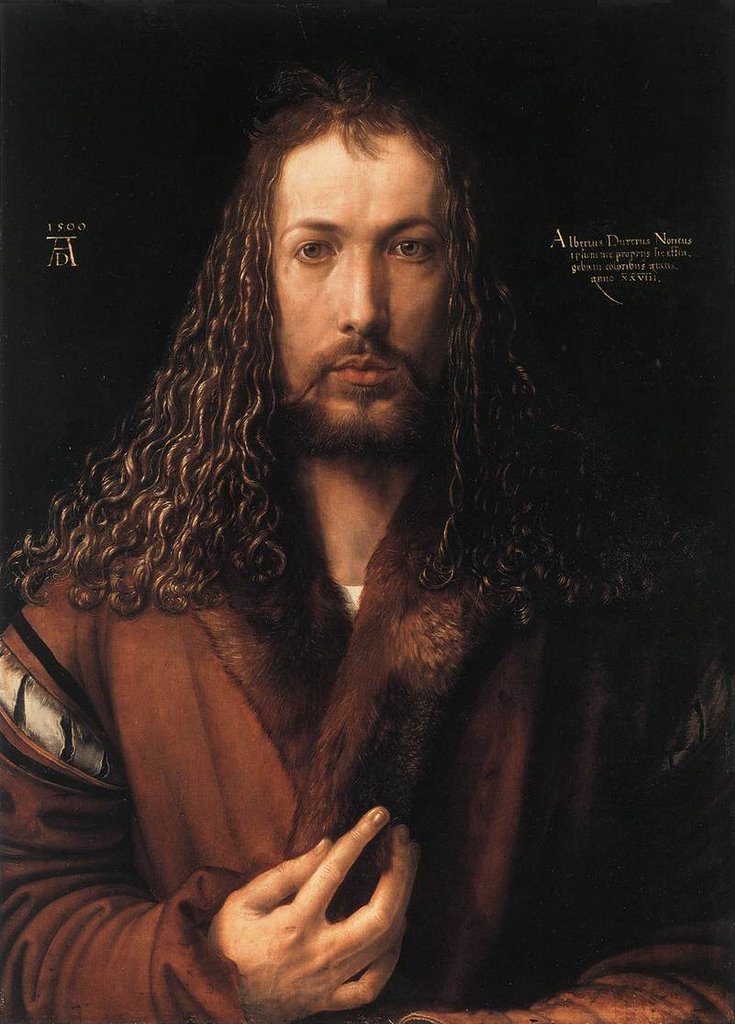
DuererAlbrecht Dürer (1471-1528), a native of Nuernberg, Germany, was one of the most learned of Renaissance artists and ranked among the great minds of Humanism. His paintings and woodcuts include examples of the splendor of creation and skilled portrayals of biblical narratives.

While great beauty and form characterize his paintings, most know him best for his woodcuts and etchings, often produced in extended series format. The Concordia Historical Institute displayed two of these series in one show: His "Life of Mary" and "Small Passion" were shown in an exhibit entitled A Sword Will Pierce Your Own Soul Too. CHI made digital copies of the individual works and they may be viewed by following the link.

Dürer never renounced Roman Catholicism, although his later writings and paintings show great sympathy toward the Reformation and ardent admiration for Martin Luther.

16 October AD 1553

CranachLucas Cranach (1472-1553), a close friend of Martin Luther, was a celebrated painter of portraits and altar pieces and a producer of woodcuts of religious subjects.

Among his portraits are some of the most noted depictions of Martin and Katy Luther and Luther's co-worker Philipp Melanchthon. He also did a number of works from Greco-Roman mythology, Biblical and hagiographic scenes, and portrayed a number of wealthy people from his time.

Among his most noted works is the altarpiece from Weimar, often thought to have been completed by his son, Lucas Cranach the Younger. The painting depicts Old and New Testament themes centering on Law and Gospel and on the crucifixion and resurrection of Christ. Cranach's intentional anachronism of including himself, Martin Luther, and John the Baptizer at the foot of the cross shows how the Church always points to Christ and benefits from His suffering and death.

Some later scholars have tried to depict Cranach as a misogynist. However, examination of his writings and the content of his paintings allows little credence for this theory.

Both Cranach and Dürer are remembered and honored for the grandeur of their works of art that depict the glory and majesty and the grace and mercy of the triune God. I've also included Michelangelo Buonarroti, although his life (both public and private) sometimes was contrary to Scripture's standards of godliness.

18 February AD 1564

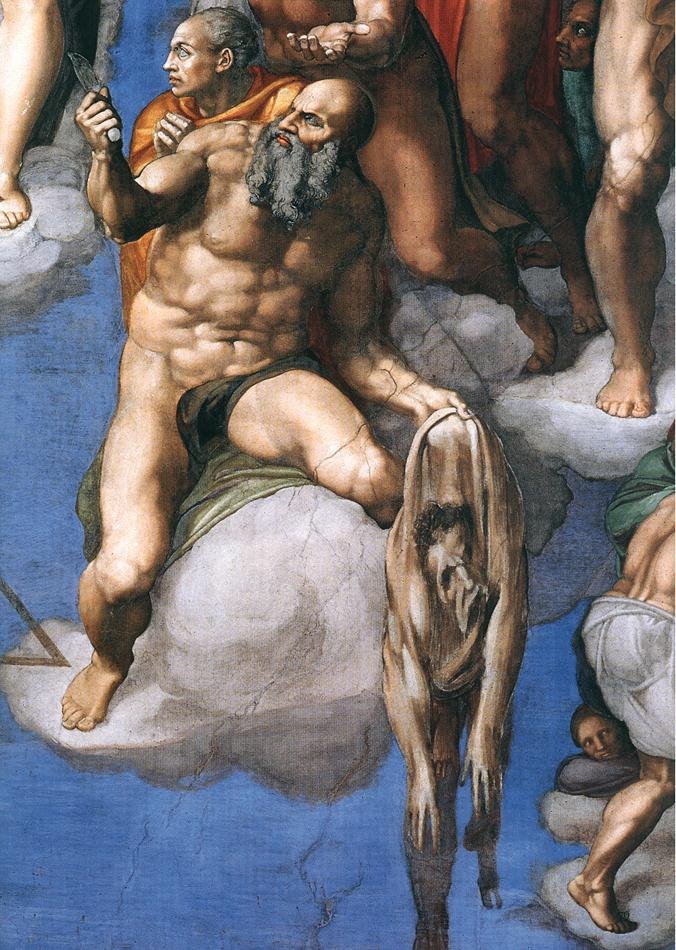
MichelangeloDuring roughly the same time that Cranach and Dürer worked in Germany, Florentine artist Michelangelo Buonarroti (1475-1564) was busy in Italy. By age 21, he'd already carved his famous Pietà, a scene of the Virgin holding her dead Son before His burial. Most will probably know him from his statue of David and his work in the Sistine Chapel.

The picture here is from his "Last Judgment" fresco; the person portrayed is Saint Bartholomew, holding the knife said to have flayed him in one hand and his peeled skin in the other. I include it because the face of the restored saint is a self-portrait by Michelangelo. Many have speculated as to why he chose this particular person to bear his image. Some think he used it to indict those who criticized him, as if to say, "You can cut away at me now, but I will be vindicated." Others believe that he wrestled throughout his life with temptation and sinful behavior but recognized that in the Resurrection he would be remade.

Collect

O God, who by your Holy Spirit give to some the word of wisdom, to others the word of knowledge, and to others the word of faith, we praise You for the gifts of proclaiming Your grace and glory through visual representation that you gave to your servants Albrecht and Lucas [and Michaelangelo], and we pray that Your Church may never be destitute of such gifts; through Jesus Christ our Lord, who lives and reigns with You and the Holy Spirit, one God, now and forever.

Technorati Tags: Duerer | Albrecht Duerer | Dürer | Albrecht Dürer | Durer | Albrecht Durer | Cranach | Lucas Cranach | Michelangelo | Michelangelo Buonarroti | art | vocation | Church Year | liturgical calendar | Christianity | Christian feasts | biography | hagiography | historical theology | Church history | European history | art history | Aardvark Alley


View article...

FW: Piety and Pietism

One Lutheran at a time…


Feed: Confessional Gadfly
Posted on: Tuesday, April 05, 2011 10:02 AM
Author: Rev. Eric J Brown
Subject: Piety and Pietism


I will admit, I feel very nervous, very hesitant when it comes to instructing in piety. I am willing to do a very simple baseline - be respectful, things like that. Or I will explain things that I do from my piety - I have no problem teaching why I make the sign of the cross when I do. And, if someone is assisting me in the service they will reverence when I want them to.

But I am not likely to write a handbook on "this is how you should do things" -- because of a very simple reason.

I view the distinction between piety and pietism as this:

Piety are those things that one does in order to focus ones self upon Christ and His promises. One should be able to articulate the why of these (as an adult).

Pietism occurs when one says that others *must* do one's own piety. Why does not come into play (either why they must or even why I do something).

I'm not going to tell someone that they must kneel during the Confession, even though I do. I like the humble posture - it reminds me that of myself I dare not stand before God almighty. But I'm not going to say, "If you don't kneel... bad!"

And of course, this applies to things outside of worship. I may choose, out of a desire to exercise self-control and discipline, to forgo X... but I can't tell another, "You need to give up X." I can explain, or even suggest if they ask -- but to command - no.

I cannot assume that I know better how to face the trials you face in your life than you do. I can warn of sin - I can suggest... but to say "Thou shall" when our Lord has not said "Thou Shall" terrifies me. It is too audacious for me. Piety suggestions must always be that - suggestions.

Because ultimately... while piety is good, the specific shape of piety doesn't matter... the size and shape of the sign isn't nearly that important, as long as the sign points to Christ.


View article...

FW: Gesundheit, Bon Appetit and Kyrie Eleison, by Pr. Rossow

Kyrie…


Feed: Steadfast Lutherans
Posted on: Tuesday, April 05, 2011 9:26 AM
Author: Pastor Tim Rossow
Subject: Gesundheit, Bon Appetit and Kyrie Eleison, by Pr. Rossow


This past Sunday, and all during the season of Lent, we at Bethany Lutheran – Naperville, Illinois, sing the Kyrie according to Lutheran Service Book (LSB) 944, "Kyrie – II." It is the standard Kyrie but in Greek. It is beautiful, meaningful and authentic. The congregation has learned it well enough that we were even able to sing part of it a cappella.

We English-speakers regularly use foreign phrases in our conversation like "gesundheit" and "bon appetit." Therefore it should not be surprising when we use a little Greek and Latin in the Divine Service.

It is off-puting then that practitioners of Contemporary Worship (CoWo) often complain about the use of ancient languages in the Divine Service in keeping with their complaints that the historic liturgy is generally old-fashioned and incapable of relating to those in our current pop culture.

Singing the Kyrie in Greek seems to be working just fine in the heart of pop culture in the thriving, yuppie, baby-boom, post-modern Chicago suburb of Naperville. As a matter of fact, if I were to judge the liturgy last Sunday on an emotional scale, I would say that the Kyrie was one of the more emotionally meaningful parts of the Divine Service. It helped that at the late service our high school youth choir sang a beautiful descant. (Yes Virginia, we do have a high school youth choir that assists the congregational singing of the liturgy and they do learn Greek and sing it.)

Singing parts of the liturgy in ancient languages, in doses that allow the average person to realize in English what they are singing, is a helpful, godly and pious practice. It keeps us tethered to the 2,000 year old liturgy. It helps us realize that we are not worshipping God according to some recently devised form but according to forms that have survived for generations. It also helps us to realize that the we worship with angels, archangels and all the company of heaven. It even brings an ethereal element into worship which helps us to transcend daily life and realize that this hour or so on Sunday morning is the most unique and important hour of the week. It is the hour when the Lord comes to us in His Word and in the Supper and bathes us in his eternal mercy – Kyrie Eleison!


View article...

Sunday, April 3, 2011

FW: How Hard It Is...

Thoughts…


Feed: Pastoral Meanderings
Posted on: Sunday, April 03, 2011 5:44 AM
Author: noreply@blogger.com (Pastor Peters)
Subject: How Hard It Is...


Of all the things we do in worship, the hardest is that which is not printed out in a hymnal or a rubric directed by red print or a sermon preached at or to us... no, the hardest thing we do in worship is that which underlies all else, namely, focus our attention off ourselves if for one brief hour.

We have been taught by culture and advertising to be fully aware of everything about us. We are consumed with how we feel (walk down any aisle in a drug store and see the myriad of concoctions sold to help us feel better).  We cannot go ten feet without a water bottle or soda in our hand -- Lord knows, we may get thirsty.  We tweet, text, email, and call people out of an incessant need to communicate how we feel at any given moment (or where we are or what we are doing or what we just saw, etc.).  We are enormously self-important in the sense that we know and think about our feelings, our health, our desires, and our needs nearly every moment of every day.  Add to that, we think about others in relationship to ourselves.  We cannot forget the guy who cut us off in traffic or the woman who slipped in front of us in line at Kroger or shopper who grabbed the very thing we were going to buy.  Of course, we are most consumed by what others have said or done to us.  Facebook pulses with what others said about us and how we think about it all.  We are tired, we are busy, we are hurting, we are bored -- oh, are we bored!

You may think that hymn was difficult to sing or that lesson difficult to follow or that sermon difficult to stay awaken through it all, but underneath it the most difficult thing we face on Sunday morning is keeping the focus, the attention, and the mind/heart off ourselves.  We fidget and yawn and gaze off into space and close our eyes and have imaginary conversations or write imaginary to do lists in our minds because it is nearly impossible for us not to think of ourselves -- if only for the worship hour.

I often remind certain acolytes that I do not care how tired or bored or whatever they are, the people in the conversation are watching them and they need to pay attention to what is going on and at least look interested.  They look back at me with questioning eyes and stutter "bbbbbbbut" to justify or excuse why they should be afforded a little leeway that Sunday.  Sometimes I wish I had the nerve to say this to the people in the pews.  There are some of us on Sunday morning who cannot resist the impulse to comment on everything that is going on around us -- and most are not as subtle as they think.  There are some of us who squirm in the pews as if we were being tortured instead of fed and nourished by the hand of God.  There are some of us who look around us as if the rest of the folks in the room were the object of Sunday morning.  And then we wonder why we did not get anything out of it. 

No, clearly the most difficult task for the Holy Spirit is to turn our attention away from ourselves for just a while each Sunday morning so that we may focus our hearts and minds upon the Word and Table of the Lord.  When the Spirit accomplishes this feat, He deserves His Sunday afternoon nap.  I rather think He is like the proverbial plate spinner who puts a porcelain piece of dinnerware on a stick and gets it spinning only to do it over and over again, running back and forth to restart a tottering plate waiting to crash.  Yet that is His work every Sunday morning, wherever God's people gather in His name.   Another Sunday morning will soon begin and we bring to the worship service our wounds, our worries, our whining... etc.  But somewhere in the midst of all the things we think and say, the Spirit will also be there pushing our eyes to see Jesus, opening our hearts to His grace, and focusing our minds upon Word and the Sacrament -- not for God's benefit, though that would surely be enough cause for His mighty labor, but for ours.


View article...

FW: On Learning How to Pray

Oremus…


Feed: Mercy Journeys with Pastor Harrison
Posted on: Saturday, April 02, 2011 8:23 PM
Author: Rev. Matt Harrison
Subject: On Learning How to Pray


I continue to learn how to pray. Over the Christmas break I usually try to make some saw dust. This Christmas past I built a litany desk/kneeler for my office. Best thing I've ever done for my prayer life. Sitting at my desk it's so easy to become distracted. There are a couple of computers, stacks of documents, notes, to-do lists, books and other miscellanea. It's awfully easy to get distracted. Last October I made a visit to Germany. While in Berlin I stayed with my old friend and dear colleague in Christ, Bishop Em. Jobst Schoene. As we perused his venerable home office, replete with vellum tomes - each with a story - I noted his kneeler. It's simple. What struck me right away was the well worn indentations from his knees, the leather pad worn dark. It struck me. I need to begin to learn to pray like this man. The kneeler project was born.


I searched the web for photos and designs I like and could reproduce in my home shop. I decided to make it inexpensively and so pounced upon some marked down lumber laying in large pile outside my local Lowe's store. For 20 bucks I got enough board feet of 2 x 12 pine to make a whole pew. The project was done in about a week and half.


I carted the contraption over to the International Center on a Sunday afternoon, and placed it in a spot in my office which cried out for it. Now, every morning, it beckons, first thing. I've been praying the litany since day one, and I simply can't in good conscience proceed with any of the day's business without hitting my knees. Copying Schoene, I've also added a couple of candles to the ritual. I'm not that great at praying. I've got much to learn and the Lord teaches prayer most intensely through trials, but I'm learning. The Litany has been a fabulous guide. How profound to pray it's petitions for the support of pastors in faithful teaching and holy living, for the needs of the church, the government, the world in times of disaster. There is not a day that goes by where one of the petitions does not strike me because of the events swirling about. How marvelous to know that each word is grounded deeply in Holy Scripture and the promises of God who asks us to pray, and promises to hear us.


There is much work ahead. There is great anxiety for the future of the church. There is a deep need for us to be on our feet, among the people of our congregations and out in the communities around our parishes. The world beckons us to come and share Christ. But none of that will happen finally, or perhaps happen in a way that truly expands the church, if we don't start it all, each and every day, from our knees, praying for our people, our pastors, our congregations, the spread of the gospel, for our families, the whole church of God on earth, and our Synod.


I'm struck by Sasse's comments in Ecclesa Orans (Letters to Lutheran Pastors V):


Our American brethren in the faith will also learn this through painful experiences. Instead of setting up a church office in Washington, it would have been better had they equipped some place somewhere in the solitude of their immense country, where prayers would be offered day and night for their government and for the peace of the world. For the church of Christ is not a church that is always busy holding conferences, nor is she a church that does business with politicians and the press. She is ecclesia orans. And this is her main calling. Either she is ecclesia orans, as indeed she showed herself to be already in the catacombs,—or she is nothing.

Let no one say that prayer is self-evident. After all, we have services once or twice a Sunday. No, that prayer of the church which we find everywhere in the New Testament where the life of an ecclesia is spoken of, unfortunately, is not something self-evident. Who would maintain that prayer is offered in our Lutheran Churches today with a fervor, which even approaches that with which the church of the New Testament prayed "without ceasing?" (Acts 12:5.) Where today is Luther's mighty praying with its visible answers? Where is the prayer of those pious people, of which Luther spoke in his explanation of the Lord's Prayer in the Large Catechism, the prayer which in those days held the Devil back from destroying Germany in its own blood? Yea, despite all the criticism which the Reformation has directed at the mumblings of Catholic prayer and which the modern liturgical movement within the Catholic Church undertook (quite independently from an entirely different viewpoint) must we not finally ask where, in which church, prayer is being offered with more fervor and perhaps also with better training—for prayer too must be learned? Will the answer be the Catholic Church or the churches of the Reformation?

Pastor Matthew Harrison


View article...

FW: The Phos Hilaron

Cantemus…


Feed: Evangel
Posted on: Saturday, April 02, 2011 5:25 PM
Author: David T. Koyzis
Subject: The Phos Hilaron


I have recently posted my freshly composed versification of the ancient Greek hymn, the Phos Hilaronς λαρόν), which is the most ancient Christian hymn outside the Bible itself, dating back at least to the 3rd century AD, if not earlier. It is an evening hymn most appropriately sung at the beginning of vespers in the Liturgy of the Hours. It is first recorded in the Apostolic Constitutions in the 4th century. St. Basil the Great spoke of it as an ancient hymn already in that same century. For the tune I have taken that for Genevan Psalm 77/86 and somewhat extended it to fit the length of the single stanza. The tune is in the hypodorian mode. I may still come up with my own tune at some point. Here is my versified text:

Joyous Light so full of glory
of th' immortal Father holy,
heavenly, hallowed, blessèd One,
Jesus Christ, at setting sun,
having seen the twilight glimmer
as the light of day grows dimmer,
we our gladdened voices raise,
singing forth our songs of praise
to the Father, Son and Spirit.
Worthy then are you to hear it
as we joyfully intone
with our voices joined as one,
Son of God, the world's life-giver,
all exalt your name for ever.

Text: 3rd century Greek hymn, versification © 2011 by David T. Koyzis
Tune: Genevan Psalm 77/86 alt., arrangement © 2006 by David T. Koyzis


View article...

Friday, April 1, 2011

New Hymnody


According to the final meeting minutes of the former LCMS Commission on Worship (June 23-24, 2010), twenty-two hymns by Keith Getty (and co-writers Kristyn Getty, Stuart Townend, et al) were approved by LCMS Doctrinal Review.

The list of 22:  

·        Across the Lands
·        All Around the World
·        Beneath the Cross
·        Benediction (May the Peace of God)
·        By Faith
·        Come, People of the Risen King
·        Compassion Hymn
·        Creation Sings
·        Every Promise
·        Father, We Have Sinned
·        Hear the Call of the Kingdom
·        Hear O Israel
·        In Christ Alone
·        Jesus Draw Me Ever Nearer
·        O Church Arise
·        See What a Morning
·        Speak O Lord
·        Still, My Soul, Be Still
·        The Power of the Cross
·        There is a Higher Throne
·        What Grace is Mine
·        When Trials Come


PJC for QBR News

FW: Songwriters Initiative Launched at CPH

From CPH…


From: Pam Cunningham
Subject: Songwriters Initiative Launched at CPH


Send it, Share it, and Sing it…Love it!


http://www.cph.org/images/topics/images/banners/topic/csi-2011-banner.jpg


Dear Lutheran Songwriters and Worship Leaders:


It has been nearly a year since Lutheran songwriters gathered together to learn, pray, and sing together. A fellowship was nurtured in conversation, worship, and study. After many months of transition and change, I am pleased to announce the release of the Lutheran Songwriters’ Initiative through Concordia Publishing House. Fifteen sacramental songs have been selected to gift to The Lutheran Church—Missouri Synod. Concordia Publishing House is pleased to release these at cph.org/songwriters. The complimentary audio CD “Singing the Sacraments of God” (item number 75-0213) may be ordered online as well.


These songs are available for churches and individuals to listen to and consider for their worship assembly. Downloadable lead sheets are also available at this web site. It is our ardent hope that the church will respond favorably and assist Concordia Publishing House in shaping for our church a song repertoire that is faithful to the Scriptures and the Lutheran confessions.


Future publishing paradigms are being considered wholeheartedly. Please share this news release with your songwriter friends and worship leaders. Help us shape the future together as one body in Christ. Many thanks for your perseverance and contribution to the life of the church.


Rev. David A. Johnson

Director, Worship Arts Resources

music + liturgy + hymnody + song

Concordia Publishing House

david.johnson@cph.org

314-268-1022


Equipping the whole Church to Sing of Christ!


Resources Received: Lies


Wright, Bradley R. E., PhD. Christians Are Hate-Filled Hypocrites...and Other Lies You've Been Told. Minneapolis: Bethany House, 2010. 253 Pages. Paper. $14.99. www.bethanyhouse.com (LHP)

FW: Ritual without the Religion.... Religion without the Ritual

Consider…


Feed: Pastoral Meanderings
Posted on: Friday, April 01, 2011 7:53 AM
Author: noreply@blogger.com (Pastor Peters)
Subject: Ritual without the Religion.... Religion without the Ritual


It seems we have trouble with the two "Rs" together -- ritual and religion.  On the one hand we have some who want the ritual but not the religion.  This would explain some Jews who maintain a kosher kitchen and follow the rigorous dietary rules yet do not believe in Messiah to come or really in God at all.  They are in their belief largely secular but in their practice they are pious.  I well recall a conversation very long ago with a daughter of a member who had decided to become a Jew, her husband being Jewish and she wanted to resolve many years of conflict (at least in practice).  "What changed when you (a Lutheran) became Jewish?" I asked.  The simple reply.  "I began keeping a kosher kitchen and observing the dietary laws of Judaism."  Later she admitted that she still kind of believes in Jesus but does not see the conflict.  She (like her husband) became an observant Jew in practice and not belief.

Add to that the many Anglicans across the world who can hardly be bested when it comes to vestments, liturgical appointments, and the finest ritual of the BCP Mass and yet they hardly believe a word of Scripture.  They have adopted every liberal social cause as their mission and they seldom speak of forgiveness, life, and salvation.  I think of folks like John Shelby Spong, Episcopal apostate Bishop, who seems comfortable within the liturgical ritual of his church but extremely uncomfortable with the tenets of the faith (traditional or orthodox).  His cause is accompanied by many of the "high church" Protestants whose practice involves ritual and gesture that would seem to betray belief and yet it does not -- at least not any belief that Athanasius might recognize.

On the other hand are those who want religion without any ritual.  This would represent most of fundamentalism and much of evangelicalism (although there are new rituals associated with the emergent church that might pass for ritual -- like the coffee and the waved arms).  This group believes that religion is almost tarnished by any outward ritual, as if it were offensive to the true worship of spirit and truth.  They take religion very seriously but do not take ritual all that seriously.  Some are confused by the desire or need for ritual and others see it as formalism.  Strangely enough, these folks seem to love the rituals associated with patriotism, sports, the lodge, etc...

Lutherans seem to be well poised to marry both the seriousness of a faith grounded in an authoritative and efficacious Scripture and the ritual that accompanies and even illustrates what is believed with the heart and confessed with the lips.  We do not have many who are in it for the ritual but who prefer their religion lite -- though it may be said that liberal Lutheranism is indeed heading toward this.  We do seem to have a number of folks who are at the least uncomfortable with ritual.  They follow the liturgy of the hymnal and wear the vestments (as few as possible) but they do not feel as comfortable at the altar as they do at the pulpit.  These are the folks who are as conservative as can be with it comes to Scripture and the Confessions but would almost prefer the old black academic or Geneva gown of Lutherans at the beginning of the last century.  Lest we forget, we also have a new wave of "Lutherans" (I am not so sure how deep their Lutheranism runs) who eschew ritual with the best of the evangelicals and who have firmly embraced the idea that they can have an evangelical style with a Lutheran substance and get by with liturgy lite and with abandoning ritual.

It would seem that with the well established liturgical movement as our recent history and the more catholic bent of nearly all newer Lutheran hymnals, Lutherans would be on the cusp of a new and strong marriage of religion and ritual.  It would seem that Lutherans would be well situated to combine a robust confessional identity, confident Law/Gospel preaching, strong Eucharistic piety, and a well ornamented liturgy.  And for many it would be true.  But the facts tell us that we Lutherans are still beset by problems marrying the seriousness of the Christian religion with a ritual that both flows from and identifies with this faith.  Whether ELCA or Missouri, WELS or ELS, or one of the newer or smaller derivations of Lutheranism in America, we still struggle with the union of religion and ritual.  Though, to be sure, we are not so diverse or extremely divided as others in the spectrum of Christian denominations.  There is some comfort in that but I hope we do not take too much of it and instead push toward the strong tie and connection between faith's confession and its practice liturgically.


View article...