Wednesday, July 9, 2014

Quick Summaries: Calvin, Apostates, Martyrdom, Cherry Creek, and Page CXVI


Quick Summaries are pithy paragraph-long reviews
of releases that cross our QBR desk. 

These are reviews for when you don't have all day 
 to decide whether a resource is worth
your time, money, storage space, or trouble.


Schroeder, Joel Allen, Director. Dear Mr. Watterson. (Documentary about the comic strip Calvin and Hobbes and its enduring cultural legacy) Pre-release online screener. http://buy.dearmrwatterson.com/ (LHPN)


Swanson, Kevin. Apostate: The Men Who Destroyed the Christian West. Parker, CO: Generations with Vision, 2013. Paper. 312 Pages. $26.95. www.apostatebook.com (LHPN)


The Project. Martyrs Prayers. Indianapolis: Saints and Survivors, 2012. (Audio CD, $12.99.) mp3 audio download, $9.99. www.themartyrsproject.com (HN) 

Zac Hicks + Cherry Creek Worship. The Glad Sound. Fort Lauderdale, FL: Cherry Creek Presbyterian Church, 2009. Audio CD. www.cherrycreekpres.org (LH)

Zac Hicks + Cherry Creek Worship.  Without Our Aid. Fort Lauderdale, FL: Cherry Creek Presbyterian Church, 2011. Audio CD. www.cherrycreekpres.org (LH)

Page CXVI. Good Friday to Easter. Boulder: SoundCloud/Page CXVI, 2014. mp3 audio download. Available April 15. http://pagecxvi.com/   http://pagecxvi.com/#store  http://blog.pagecxvi.com/ (H)


Today, we'll consider Calvin (the boy, not John C.), apostates and martyrs, and other music, specifically Hymns Resurgent.


+ Substantial, thoughtful, personal, and artistic in its own right, we like Director Joel Allen Schroeder's professional fan film approach to his film, Dear Mr. Watterson, "A cinematic exploration into the impact of the greatest comic strip in the history of the universe: Calvin & Hobbes. French, German, Spanish, Portuguese, & Swedish subtitles available. (The 90 minute feature film)" (film website)  We at QBR still miss the comic strip. Personally, it ended along with The Far Side while I was at university. I spent some Christmas money on the hardcover complete collection of both. We are hopeful that Mr. Watterson will respond to the film with more of our favorite tiger/boy team. Recommended for fans. Watch or buy online! Need an introduction to 3,160 strips of C&H? Pick up a paperback compilation and return for more.


+ It's hard to argue with the author of Apostate. I could understand those who would say he overstates his case. Given that so many have understated or ignored the damage to Western Civilization by Marx, Darwin, Nietzsche, Dewey, and Sartre, I'm willing to give Kevin Swanson the benefit of the doubt. This is spiritual warfare. Apostate exposes The Men Who Destroyed the Christian West. This is in-depth, riveting, informative reading. I read it in one sitting, but I do not recommend that approach or experience to others. The book reads like an autopsy report while the patient is living, yet likely terminal. I do not share the grim post mortem of the author, yet I wish to be generous in my appreciation for what will be difficult to accept yet true points about decline. Oremus! Kyrie! And Consider...


+/ I listened to Margaret Becker, Phil Keaggy, and Glenn Kaiser in the 1990s and wondered what they were up to today. This is it. Visit www.themartyrsproject.com/ for more information about a book (which I have not seen) that gave inspiration for these songs, which may give the current generation pause to think about what it means to be a martyr for Christ. Is Bonhoeffer a martyr? Some may question his status in that category. LCMS Lutherans should note that the video for Romero was partially filmed in Kramer Chapel of Concordia Theological Seminary since it had the same "modernist" feel as the hospital chapel in San Salvador where Romero was shot. While not music I would use in public corporate worship, it would be worthwhile for others to hear, consider, and upon which to reflect. Consider the words of Cardinal Francis George: "I expect to die in bed, my successor will die in prison and his successor will die a martyr in the public square. His successor will pick up the shards of a ruined society and slowly help rebuild civilization, as the church has done so often in human history." Perhaps this CD would be a good companion to the previous book.

We've considered a variety of groups and individuals recovering the use of historic Christian hymns in a fresh way. While not all are models we would encourage you to imitate on Sunday Morning, we do believe they are worthy of your attention.

+ Cherry Creek is a Colorado congregation that belongs to the Evangelical Presbyterian Church. Zac Hicks is based in Fort Lauderdale, Florida and is Pastor of Worship at Coral Ridge Presbyterian Church (home church of Dr. D James Kennedy, former pastor and of current Senior Pastor, William Graham Tullian Tchividjian). Together, Zac Hicks + Cherry Creek Worship have released two albums, The Glad Sound and Without Our Aid that highlight new arrangements of hymn texts by Phillip Doddridge, Isaac Watts, Reginald Heber, Charles Wesley, Johann Rist, William Kethe, and Ambrose of Milan, et al. Chord charts are here: http://www.zachicks.com/lyrics-charts-more/. I am thankful for yet another example of hymns being intentionally brought back into the worship life of Christ's Church. When you have time, consider the new music settings Hicks provides for Luther texts. You'll have a lot to read. Hicks is a prolific blogger.

+ Our friends at Page CXVI return with an album intended to conclude their set for the festival half of the Church Year. I commend them for that rediscovery (the Church Year) as well as their passion for hymns. Chord charts are here: http://pagecxvi.com/media/charts/PageCXVI_Good_Friday_To_Easter_ChordCharts.pdf 
Hear their take on "O Sacred Head How Wounded, "Go To Dark Gethsemane," "Three, "Roll Away the Stone," "Christ is Risen," "Christ The Lord has Risen Today," Townend's "How Deep the Father's Love For Us," and "Hallelujah." We encourage the band to look for hymns for the Pentecost/Trinity half of the Church Year.


More information about each of these titles
may be found on each respective publisher's website. 


The Rev. Paul J Cain is Pastor of Immanuel Lutheran Church, Sheridan, Wyoming, Headmaster of Martin Luther Grammar School, Yellowstone Circuit Visitor (LCMS Wyoming District), a permanent member of the Board of Directors of The Consortium for Classical and Lutheran Education, Wyoming District Worship Chairman, and Editor of QBR.

Monday, July 7, 2014

Quick Summaries: Belonging, Poverty, Stress, and Lutheranism


Quick Summaries are pithy paragraph-long reviews
of releases that cross our QBR desk. 


These are reviews for when you don't have all day 


to decide whether a resource is worth
your time, money, storage space, or trouble.

 
Chute, Anthony L., Christopher W. Morgan, and Robert A. Peterson, Editors. Why We Belong: Evangelical Unity and Denominational Diversity. Wheaton: Crossway, 2013. 251 Pages. Paper. $18.99. http://www.crossway.org/books/why-we-belong-tpb/ (LHP)

Corzine, Jacob and Bryan Wolfmueller, editors. Theology is Eminently Practical: Essays in Honor of John T. Pless. Fort Wayne: Lutheran Legacy, 2012. 272 Pages. Paper. $16.95. www.lutheranlegacy.org (LHP)


DeYoung, Kevin. Crazy Busy: A (Mercifully) Short Book About a (Really) Big Problem. Wheaton: Crossway, 2013. 124 Pages. Paper. $11.99. http://www.crossway.org/books/crazy-busy-tpb/ (LHP)


Grudem, Wayne and Barry Asmus. Foreword by Rick Warren. The Poverty of Nations: A Sustainable Solution. Wheaton: Crossway, 2013. 399 Pages. Paper. $30.00. http://www.crossway.org/books/the-poverty-of-nations-tpb/ (LHP unsol)


Jenson, Robert W. A Large Catechism. Delhi, NY: American Lutheran Publicity Bureau, 1991, 2013. 72 Pages. Paper. $6.00.  http://alpb.org/catechism.html (P)


Braaten, Carl E., Editor. Preaching and Teaching the Law and Gospel of God. Delhi, NY: American Lutheran Publicity Bureau, 2013. 174 Pages. Paper. $14.00.  http://alpb.org/preachingandteaching.html (LHPQ)


Bansemer, Richard F. Prayers of the People: Petitionary Prayers Guided by the Texts for the Day. Delhi, NY: American Lutheran Publicity Bureau, 2014. 197 Pages. Paper. $11.00. http://alpb.org/prayers.html (L)


Hill, Kathryn Ann. To You It Has Been Given: The Parables of Jesus in Picture and Verse. Fort Wayne: Lutheran Legacy, 2011. 100 Pages. Paper. $13.95. www.lutheranlegacy.org (HQ)


Let's cover a lot of territory quickly.


- My cautious optimism about this book quickly became disappointment. Granted, "no contributor can speak for his denomination as a whole" (17). Authors who contribute this way should we aware of the consequences of their words. Two in particular worked against the unity concept of the book as a whole. Chute's essay fails to comprehend what was at stake for Luther, Lutherans, and Christendom at Marburg (49, 64). Sweeney's essay on Lutheranism (111ff)will disappoint Lutherans of every stripe I can think of. His comments on the LCMS and WELS were offensive to me, judgmental, and show a similar lack of depth of appreciate for the Sacrament as Chute (131). The back of the book promised me "natural without being negative" and failed. Good concept. Uneven execution. Not Recommended.


+ Notable names pay homage and give their thanks to the Lord for John T. Pless in this new release. Pless' imprint on each of the contributors is evident. One notes theological depth, Confessional commitment, and appropriate humor in the essays. All the essays in their own way speak to the habitus practicus of Lutheran pastoral care and practice, grounded in Holy Baptism, Holy Absolution, and Holy Communion administered by one called into the Office of the Holy Ministry. Essayists highlight issues with James and Paul, apologetics, reason, Justification and atonement, Lutheran evangelical catholic identity, spiritual warfare, and the proper distinction between law and Gospel. Apart from sharing a Lutheran beverage and the typical accompanying incense with the good professor, this volume is an appropriate way to honor Rev. John Pless.
 

+ Winner of the 2014 Christian Book of the Year Award, Crazy Busy is an appropriate brief and personal book about the self-inflicted madness of the four-letter-word BUSY. Seven diagnoses help the reader put an end to "busyness as usual" (back cover). I have an appreciation for this author's writing style and previous books. There's a fundamental problem when "busy people can't handle long sermons" (110). As Martha. Ask Kevin DeYoung. He admits that he is a work in progress (14). Time is precious. We all need that Sunday rhythm (99). Life without God in Christ is meaningless. So is busyness. Recommended. We'll look for more from this author soon.


+ The Poverty of Nations was such a pleasant surprise, I thought of upgrading this title to a full review rather than one among many in a Quick Summary. My initial bias against the book was simple: I do not appreciate the theology, publicity, or pastoral practice of the author of the Foreword. I do not hold that against the authors, Grudem and Asmus. Their sustainable solution to deal with world poverty is local, national, and global in scope, paying respect to both common sense and the memory of Adam Smith's The Wealth of Nations. The free market and political freedom have worked for the West. Why not try them in the rest of the world. Read Hayek's The Road to Serfdom, this volume, and work to promote the values of the Appendix (369).

/ I can both appreciate and disagree with the writing of Robert Jenson. On the Inspiration of Scripture was honest, yet too innovative for me. I can welcome the insights of Lutheran Slogans while differing with the author on details. Commandments, Creed, and Prayer form the foundation for his A Large Catechism. I cannot agree with multiple forms and meanings of marriage (11). His passion for the Holy Baptism is evident in his frustration about misuse (53). Finally, I must commend his good point about direct pastoral administration of the Sacrament of the Altar while rejecting a dual he/she pronoun on who may be ordained to the pastoral office (71). 


+ Designed for the Revised Common Lectionary (RCL) and easily adaptable for LCMS use in our Three Year Lectionary from Lutheran Service Book,  Rev. Bansemer's Prayers of the People provides the wider church Petitionary Prayers Guided by the Texts of the Day. Clearly a labor of love, the approach is similar to the Let Us Pray weekly prayers provided by LCMS Worship.  Prayers are adaptable and churchly, yet use fresh language chosen by the author based on his academic study, pastoral heart, and knowledge of the Bible texts for each day.


+/ Consisting of "Papers Delivered at the 2012 Theological Conference Sponsored by Lutheran CORE and NALC, August 15-16, 2012 at Calvary Lutheran Church, Golden Valley, Minnesota," Carl E. Braaten serves greater Lutheranism by presenting this set of essays on Law and Gospel. Lutheran, Reformed, and Roman Catholic essayists hold forth, including Michael Horton and Jared Wicks. Schifrin's essay (151) highlights a progressive misunderstanding of what I/we in the LCMS mean about Scripture being holy, inerrant, and inspired. This straw man approach is disappointing. Wicks does well to connect Luther to Bernard of Clairvaux (65). Worth reading, but without many surprises. I am very thankful for the CORE and NALC continued dedication to meet to do theology together.
 
+ Closing on a strong positive note, this reviewer thanks the Lord for the latest release of the poetry/hymnody of prolific and gifted writer Kathryn Ann Hill. Hill's collection has 43 original metrical poems based on 42 NKJV parable texts accompanied by 19 wood engravings by John Everett Millais. A Scripture index is included plus a list of recommended hymn tunes (95) to sing these Parables of Jesus in Picture and Verse.  I personally resonated most with "The Prodigal Son" (80) and "The Talents" (49). Thank you to Lutheran Legacy for publishing this volume and sharing a copy of it with us. 


More information about each of these titles
may be found on each respective publisher's website. 


The Rev. Paul J Cain is Pastor of Immanuel Lutheran Church, Sheridan, Wyoming, Headmaster of Martin Luther Grammar School, Yellowstone Circuit Visitor (LCMS Wyoming District), a permanent member of the Board of Directors of The Consortium for Classical and Lutheran Education, Wyoming District Worship Chairman, and Editor of QBR. 


View article...

Received for Review


Kornacki, Alan. Lutheran Purgatory: Pastors Without Calls. Amazon Createspace, 2014, 72 Pages. eBook. $4.99 ($2.99 currently) http://www.amazon.com/Lutheran-Purgatory-Pastors-Without-Calls-ebook/dp/B00L84ZWZK (LHP)


View article...

Pulpit Review: Concordia Commentary


Schuchard, Bruce G. 1-3 John (Concordia Commentary). St. Louis: Concordia, 2012. 756 Pages. Cloth. $49.99. https://www.cph.org/p-21567-john-1-2-and-3-concordia-commentary.aspx (LHP)


Middendorf, Michael P. Romans 1-8 (Concordia Commentary). St. Louis: Concordia, 2013. 802 Pages. Cloth. $49.99. https://www.cph.org/p-7380-romans-1-8-volume-1-concordia-commentary.aspx (P)


Bollhagen, James. Ecclesiastes (Concordia Commentary). St. Louis, Concordia, 2011. 475 Pages. Cloth. $49.99.  http://www.cph.org/p-7386-ecclesiastes-concordia-commentary.aspx (P)


Voelz, James. W. Mark 1:1-8:26 (Concordia Commentary). St. Louis, Concordia, 2013. 737 Pages. Cloth. $49.99.  http://www.cph.org/p-7378-mark-11-826-concordia-commentary.aspx (P)


With great joy, we present to you four volumes of Concordia Commentary.

These epistles represent the singular voice of an extraordinary theologian. John, the last living apostle,writes to his "children." For decades he has served as the elder father of the house churches of Asia Minor, but during his exile, false teaching has persuaded some to abandon the faith and the life of the community of the beloved. At least one church's leader has presumed to advance his own teaching at the expense of the apostle's instruction. Knowing that his days are numbered, John sends a general epistle, 1 John, together with its introductory cover letter, 2 John. In order to address the errant leader's conduct, he also sends a situation-specific, personal and pastoral addendum, 3 John. Rallying the faithful so that none would be lost to the ongoing threat of deception, John urges his children to confess by the Spirit in this last hour the man Jesus as the Son of the Father, come in the flesh in truth and love. The fulfillment of God's historic dealings with his people of old is Jesus' atoning sacrifice of himself. Through his shed blood, a cleansing flood, God confers the life of the age to come.

Dr. Schuchard is a graduate of the University of Michigan in Ann Arbor, Michigan (B.S., 1979), and Concordia Theological Seminary, Fort Wayne, Indiana (M.Div., 1984), where he also earned the S.T.M. degree in 1985. His Ph.D. in biblical studies is from Union Theological Seminary in Virginia, Richmond, Virginia (1991).

(Publisher's Website)

Dr. Schuchard was one of my advisors while I was at seminary. Since graduation, I've contacted him on occasion (but not too often) with a difficult Bible Class question from my congregations. This is a volume you need to find those answers in your own bookcase.
 

Schuchard helps you comfort others with the forgiveness of sins, cleansing "from all unrighteousness" (1 John 1:8-9, 140ff), deal with the separatists of 1 John 2:19 (14ff, et al) and Antichrist (264ff, etc), and better explain "He first loved us" (1 John 4:11-21, 491ff), "the Elect Lady and Her Children" (2 John, 591ff), and the identity of "Gaius" (3 John, 669ff). 

Think of it as a bargain. One volume. Three Bible books... 

The Concordia Commentary Series: A Theological Exposition of Sacred Scripture is written to enable pastors and teachers of the Word to proclaim the Gospel with greater insight, clarity, and faithfulness to the divine intent of the biblical text.

This landmark work will cover all the canonical books of the Old and New Testaments, interpreting Scripture as a harmonious unity centered in the person and work of Jesus Christ. Every passage bears witness to the Good News that God has reconciled the world to Himself through our Lord's life, death, and resurrection.

The commentary fully affirms the divine inspiration, inerrancy, and authority of Scripture as it emphasizes "that which promotes Christ" in each pericope.

Authors are sensitive to the rich treasury of language, imagery, and themes found throughout Scripture, including such dialectics as Law and Gospel, sin and grace, death and new life, folly and wisdom, demon possession and the arrival of the kingdom of God in Christ. Careful attention is given to the original Hebrew, Aramaic, or Greek. Further light is shed on the text from archaeology, history, and extra-biblical literature. Finally, Scripture's message is applied to the ongoing life of the church in terms of ministry, worship, proclamation of the Word, Baptism, the Lord's Supper, confession of the faith--all in joyful anticipation of the life of the world to come.


Click Here to view all Concordia Commentaries.

Click Here to learn how to save 30% as a Concordia Commentary Subscriber.

(Publisher's Website)


Next up, Romans:


This commentary articulates the meaning of the Greek text of Romans in its original context for the benefit of the church and world today. Those without any knowledge of Greek will also profit from utilizing the volume. It provides insights that will enhance the understanding and effectiveness of scholars, pastors, and teachers who have the privilege of proclaiming Paul's most famous letter. This commentary seeks to be theologically thorough in as few words as possible. Romans is the Spirit-breathed, living, and powerful Word of God. Its purpose is to bestow the righteous of God, which comes through faith alone, and to inculcate the life of faith in and through our Lord Jesus Christ.

Michael P. Middendorf was born and raised in St. Paul, Minn. He received all of his education at Lutheran schools, including a B.A. in pre-seminary studies from Concordia University-St. Paul (1981). He worked there for three years as an admissions counselor and guest instructor of Greek before enrolling at Concordia Seminary, St. Louis, MO., where he earned his M.Div. (1987), S.T.M. (1989), and Th.D. (1990) degrees. Dr. Middendorf served as a parish pastor in Jamestown, N.D., from 1990 to 1992 and as a professor of religion and biblical languages at Concordia University Texas (in Austin) from 1992 to 2001. Since then he has been professor of theology in Christ College, at Concordia University Irvine, in California. Hi is also a pastoral assistant at Trinity Cristo Rey Lutheran Church, a bilingual congregation in Santa Ana, Calif. 

(Publisher's Website)

The availability of this commentary for the first eight chapters of St. Paul's letter to the Church at Rome gave me the opportunity to revisit Romans with my midweek adult Bible Class. It seems that Lutherans study Romans and Galatians often (or should), yet it can be a struggle for a parish pastor to keep things fresh, as well as faithful. Dr. Middendorf is your guide to the latest in scholarship that is faithful to the Scriptures and the Lutheran Confessions.


The good professor and pastor will help his brothers in the Office of the Holy Ministry defend against "Perspectives on Paul and the 'New Perspective'" (40ff), homosexual conduct (145ff), and confess anew the core of Romans, 3:21-26 (277ff). Middendorf gives the reader an overview of Baptism in Paul (475ff), helps us better understand how to resolve the dilemma of the Law and I of Romans 7:14-24, (580ff), the necessary contrasts and tensions of Romans 8:5-13, (616ff), and how to prepare for volume two of this commentary (30ff).


Read Romans anew with this Romans 1-8 Concordia Commentary.


I am very thankful for the Ecclesiastes volume. Respectfully, I do have one disagreement with the author.


Outside of God in Christ, all is vanity (41ff, passim). With God in Christ, life has meaning.

The key to understanding this difficult book is God's wisdom in Jesus Christ. Solomon realistically appraises many human endeavors and finds them to be futile. The things of this world are temporary, and life is fleeting. Yet the Gospel endows our lives with eternal significance. Divine wisdom instills fear and faith in God. This knowledge enables us to serve meaningfully in our vocations and pass through the coming eschatological judgment into eternal life.

This commentary is perfect for the pastor seeking to study, preach, and teach Ecclesiastes. It provides insightful wisdom and mature theological reflection on this enigmatic book of Holy Scripture. Dr. Bollhagen draws on his lifetime of faithful service as a seminary professor and parish pastor as he writes with practical wisdom for daily living.

Dr. James G. Bollhagen formerly was a professor of exegetical theology at Concordia Theological Seminary, Ft. Wayne, Indiana. He currently serves as pastor of Grace Lutheran Church in St. Cloud, Florida. He studied at Concordia Seminary, St. Louis (M.Div., S.T.M., Ph.D.).

I love having active men at our congregation as regular participants in Sunday morning Bible Study. "Pastor, let's do Ecclesiastes. I've never been to a Bible Study on Ecclesiastes." Neither had I. I thought a month would be enough to prepare. I was wrong. I ran into a wall at Ecclesiastes 11:1. And I have another blogging pastor to thank for a solution.
 
What does it mean to cast your bread on the waters? Bollhagen notes the parallels of Genesis 1:2 and 7:8 plus Exodus 32:20 (377). I would argue that there is a difference between the Genesis and the Exodus texts. Gold, even gold dust, sinks. He notes an article by Homan, "Beer Production by Throwing Bread into Water" (383), but too quickly discounts it. There are follow-up articles by Homan that lend more gravity (dare I say "specific gravity"?) to his thesis. Let's say the author of this commentary "disbelieved for joy." Yes, verses 1-4 of this chapter could be called "Seizing Opportunities," but verses one and two belong together. Verse one is about the brewing as Homan asserts, for it makes little sense to let Muslims interpret this verse (as generosity), nor have theological liberals fantasize about shipping bread overseas. Verse two is about generosity, and sipping the mild 2-3% un-hopped brew through straws with seven or eight buddies.
 
Consider doing your own Bible Class on Ecclesiastes. With help from this former professor and current pastor, Dr. Bollhagen's commentary will give you courage to help others find meaning in life and the book of Ecclesiastes.


Essential to every library, Dr. Voelz' volume on the first part of the Gospel according to St. Mark will be a blessing for preachers of the Three-Year or Historic One-Year lectionaries.


Immediately. Remember that word.

The reign of God has come in Jesus Christ, but in hiddenness, in humility and lowliness. Jesus came to serve and give his life as a ransom for many (10:45). Jesus promised a triumphant revelation of himself after the cross (14:28), but within Mark (ending at 16:8) the disciples do not yet see the glorious, risen Christ. They only have his Word (16:6–7).

So also we Christians do not see him and the kingdom fully implemented and manifested now. How difficult it is to be faithful on the basis of the Word alone—the disciples are testimony to that fact! If you had been there, it would not have been any easier for you than it is today. The evidence you have is what the disciples and the women had, also on that Easter morning: the promise of His Word, a Word that is ever sure.

James W. Voelz is professor of exegetical theology (New Testament) at Concordia Seminary, St. Louis, Mo., where he has taught since 1989. Previously he taught at Concordia Theological Seminary, Springfield, Ill./Fort Wayne, Ind. (1975–1989), and served as pastoral assistant at Zion Lutheran Church, Fort Wayne (1984–1988).

Dr. Voelz is a graduate of Concordia College, Milwaukee, Wis. (A.A., 1965), Concordia Senior College, Fort Wayne (B.A. in classics, 1967), and Concordia Seminary, St. Louis (M.Div., 1971). He earned his Ph.D. in biblical studies from Cambridge University, England (1978). He has done post-doctoral study with Bo Reicke (1982) and George B. Caird (1983). He is a member of Studiorum Novi Testamenti Societas (SNTS), the international NT society, in which he has been co-chair of seminars for over twenty years, including "The Greek of the New Testament." He has presented numerous papers at the SNTS and at the Society of Biblical Literature, in which he is also on the steering committee of the Mark Section. His Fundamental Greek Grammar has been published by Concordia Publishing House since 1986, and his hermeneutics textbook, What Does This Mean? Principles of Biblical Interpretation in the Post-Modern World, since 1995. His essay "The Language of the New Testament" in Aufstieg und Niedergang der römischen Welt (1984) is a standard in the field. Dr. Voelz has lectured widely throughout The Lutheran Church—Missouri Synod at conferences for pastors and laity alike.


Jim and Judy (née Hayes) have been married since April 2, 1977, and have one son, Jonathan.

Given the importance of the Gospel according to Mark, Dr. Voelz provides more depth of scholarship than you may have seen before in similar volumes (e.g. 91ff, passim). He details linguistic features (2ff), "historical present" (15ff), plot (44), two outlines of the Gospel account (geographical, narrative, 48-49), the ending of Mark (55ff, more in future volumes), and traditional major isagogical issues (74ff) before delving into the Greek of each section.


Each pericopal section has an introductory paragraph for overview (91), the text in Greek (92), Voelz' own English translation (92), and a section on Linguistic Essentials (Grammar Basics, Marcan Usage, and Features for Literary Effect, 93) before the traditional CC Textual Notes (93) and Commentary (108). It all seems expanded. What a wealth of new information!


Your parishioners will benefit from Dr. Voelz' excursus on The Baptism of Jesus and Christian Baptism (138ff), an article well worth the cost of buying this volume.


We thank Concordia for its ambitious and consistent publishing schedule for Concordia Commentary. We very much look forward to reading, reviewing, and using forthcoming volumes on Isaiah 56-66 and Galatians.


The Rev. Paul J Cain is Pastor of Immanuel Lutheran Church, Sheridan, Wyoming, Headmaster of Martin Luther Grammar School, Yellowstone Circuit Visitor (LCMS Wyoming District), a permanent member of the Board of Directors of The Consortium for Classical and Lutheran Education, Wyoming District Worship Chairman, and Editor of QBR. 


View article...

Friday, June 27, 2014

LHP Review: Luther


Luther, Martin. Edited by Benjamin T. G. Mayes and James L. Langebartels. Church Postil I (Luther's Works 75). St. Louis: Concordia, 2013. 460 Pages. Cloth. $49.99. https://www.cph.org/p-22560-luthers-works-volume-75-church-postil-i.aspx (LHP)

Luther, Martin. Translated by Holger Sonntag. Edited and arranged by Paul Strawn. What is Marriage, Really? From Two Marriage Sermons On Hebrews 13:4 and Ephesians 5:22-33. Minneapolis: Lutheran Press, 2013. 116 Pages. Paper. $.6.00. www.lutheranpress.com (LHP)

Springer, Carl P. E. Luther's Aesop. Kirksville, MO: Truman State University Press, 2011. 249 Pages. Paper with flaps. $39.95. http://tsup.truman.edu (LHP)

Countdown Commemorative Medallions to the 500th Anniversary of the Reformation (Dr. Martin Luther; Luther Caught in a Lightning Storm; Luther Becomes a Monk; Luther Travels to Rome; Luther Receives Doctor of Theology Degree; Luther's Tower Experience). Delhi, NY; American Lutheran Publicity Bureau 2011-2013, projected through 2017. Prices vary from $1 to $18 each. http://alpb.org/martinluthermedal.html (LHPN)


Walther. Gerhard. Luther. Each of our reviews posted today feature at least one sermon collection by these giants and Fathers of our Lutheran tradition. 

This review focuses on recent releases with content by Luther himself.


According to the original CPH prospectus for the addition of volumes 56-75 to the American Edition of Luther's Works, there were to be twenty volumes.

I rejoice to report that there are now twenty-eight planned volumes (http://www.cph.org/p-22560-luthers-works-volume-75-church-postils-i.aspx)!

Church Postil I is numbered as Volume 75. With the addition of eight more volumes, we can surmise (and pray) that more than the previously-announced three volumes will feature Luther sermons. The back flap of the dust cover confirms this: "Volumes 75-79 of the American Edition of Luther's Works, for the first time in 300 years, provide readers with Luther's mature, final version of the Church Postil, along with footnotes identifying the great reformer's own changes." Pray with me for patience as we await more news. Will the House Postil be included?

From the beginning of his work on the postils, Luther had stated that they were supposed to serve common pastors and people, and thus were to be the great devotional book of the Reformation.

Martin Luther's collected sermons for the church year were originally published in two series: the Church Postil and the House Postil. These were among his most popular works. Aside from his catechisms, they did more to teach people the Reformation than any other book. Volume 75 gives the sermons on the Epistle and Gospel readings from Advent through Christmastide in fresh, clear English.

Benefits of Luther's Works, American Edition, vol. 75 (Church Postil I)

1. Accurate and clear translation. (An early 20th-century version of these sermons was inaccurate and stilted.)
2. Presents the Church Postil as the mature Luther wanted it to be:

-Includes Luther's often-extensive revisions to his own work, with significant variant readings from earlier editions translated in the footnotes.

-Includes the version of the summer sermons that Luther approved (Cruciger's edition, not Roth's edition).

-Epistles and Gospels are interspersed as they were originally printed, showing the progression of Luther's teaching through the course of the church year.

(The early 20th-century Lenker version followed the revisionist 1700 edition of Philipp Jakob Spener, not Luther's mature, final edition of 1540 and 1544.)

3. Includes the careful, explanatory introductions and footnotes that have become a hallmark of Luther's Works: American Edition.

4. Includes cross-references and a table showing where Luther's sermons can be found in the German originals.

5. Fully indexed.

Edited by Benjamin T.G. Mayes and James L. Langebartels.

Read Luther's sermons (alongside those of Gerhard and Walther) to better preach to your own people, especially if you are using the One Year Lectionary.

It was interesting to read how Gerhard (xxv) discouraged preachers from imitating Luther's wandering preaching style. My wife would agree. :)

What should be sought and expected in the Gospels? Read Luther's answer (7ff).

For Luther on the church as "mouth house," see 11 n. 9, 39 n. 36, and 51 n. 72. Don't miss this!

Note Luther's sermon text for St. John's Day: Ecclesiasticus (Sirach) 15:1-6.

We're returning to Luther's form of the postil (xxviii). Blame Spener's 1700 edition for the poor editions ever since(back flap). Watch footnotes for significant variants (xxx, passim). Compare these translations to Lenker at your leisure (xxxii).

Yes, this edition is far better than the seven-volume set recently reprinted by Baker. Save your money. Buy this and not that one. 


Stock up on copies this Lutheran Press edition of Luther From Two Marriage Sermons On Hebrews 13:4 and Ephesians 5:22-33 to catechize couples preparing for Holy Matrimony and to defend Biblical marriage.


Understand Holy Matrimony better at the feet of Dr. Luther as he repeats with clarity what the Scriptures teach regarding it.

What is marriage? A common understanding is that it is a legally binding arrangement between two individuals in which they are granted certain legal rights and privileges by society. But is that all marriage is? Isn't there something more to it that a simple legal arrangement? Martin Luther answers this question with a resounding "Yes!" and in the process, lays out what marriage truly is, how it is created, and how it is joyously maintained. This is a must ready for anyone contemplating marriage, or for those already married.


Formatted into 17 simple chapters along with study questions, this book is perfect for personal devotion or Bible study.

Indeed. Sonntag and Strawn give the Church a timely, accessible, and substantive catechetical tool. 

Without the Word, marriage disintegrates.


Buy it. Use it. Give it away. Buy more. Do so to encourage Lutheran Press to produce more titles like this.


Springer's Luther's Aesop is a pleasant and scholarly surprise from Truman State University Press.


While not yet the children's' edition of Luther's Aesop that Lutheran parents would read in illustrated form to their children as catechetical bedtime stories, this is the necessary and scholarly groundwork for such a set of future publications.

Reformer of the church, biblical theologian, and German translator of the Bible Martin Luther had the highest respect for stories attributed to the ancient Greek author Aesop. He assigned them a status second only to the Bible and regarded them as wiser than "the harmful opinions of all the philosophers." Throughout his life, Luther told and retold Aesop's fables and strongly supported their continued use in Lutheran schools.


In this volume, Carl Springer builds on the textual foundation other scholars have laid and provides the first book in English to seriously consider Luther's fascination with Aesop's fables. He looks at which fables Luther knew, how he understood and used them, and why he valued them. Springer provides a variety of cultural contexts to help scholars and general readers gain a deeper understanding of Luther's appreciation of Aesop.

Classical educators should take note of this book (and practice their German and Latin on the Coburg fables).


Finally, we highlight a celebratory project of our friends at ALPB:

MARTIN LUTHER MEDAL COUNTDOWN PROJECT

Between 2011 and 2017 - the 500th Anniversary of the Reformation - give the children, their families and all members of your congregation a series of 9 medallions in gold anodized aluminum to collect to create excitement in learning about Luther and the Reformation. For adults interested in collecting the series and numismatic and historic collectors, medals will also be available in antique bronze and .999 silver.

Martin Luther Medals

Images of the finished gold anodized version of medals number 1, 3 and 5, and the antique bronze version of medals number 2 and 4. The obverse of each medal is similar, focusing on Luther (either as a monk or doctor of the church) looking left at an image suggesting the event depicted on the reverse side - here the lightning storm (#1), the door to the Erfurt Monastery where Luther became a monk (#2), the city of Rome (#3). the tower of the Castle Church in Wittenberg where he received his doctor's degree (#4) and Luther's tower study in the Augustinian monastery in Wittenberg (#5). Actual size of medals is 1 1/2 inches. Click on the image above for a larger version, then click again to magnify.

NINE MEDALS BETWEEN NOW AND THEN

Luther in Lightning Storm (1505) - Available Now
Luther Ordained a Priest (1507) - Available Now
Luther Travels to Rome (1510 -1511) - Available Now
Luther Receives Dr. of Theology Degree (1512) - Available Now
Luther's "Tower Experience" (1513) - available in 2013
Frederick the Wise Blocks Tetzel from Saxony (1514) - available in 2014
600th Anniversary of Jan Hus's martyrdom (1415) - available in 2015)
Charles V becomes King of Spain (1516) - available in 2016
Luther Posts His 95 Theses (1517) - available in 2017


Collector's Board

Martin Luther Medals
(click here for larger image)

A collector's medal holder is now also available. It can be ordered below for $5.50 plus $2 shipping and handling.

With orders for 25 or more gold anodized aluminum medals two gifts will be provided: 1 - Reformation Countdown Hymn, "Hammer Blows Heard Round the World" by Scott Blazek and Reagan Mullin, with each stanza focusing on the theme of one of the medals (with permission to copy in church bulletins) and 2 - children's sermon ideas by Fred Schumacher for use at distribution of medals.

We were provided with the pictured collector's board with the first six medals. It will be a teaching tool at my classical Lutheran school this October. Now, I need to order some of the coins for the students to take home!


I've said it before and write it again: read more Luther for the sake of the Gospel and your hearers in Jesus' Name!


The Rev. Paul J Cain is Pastor of Immanuel Lutheran Church, Sheridan, Wyoming, Headmaster of Martin Luther Grammar School, Yellowstone Circuit Visitor (LCMS Wyoming District), a permanent member of the Board of Directors of The Consortium for Classical and Lutheran Education, Wyoming District Worship Chairman, and Editor of QBR.


View article...

Pulpit Review: Gerhard


Gerhard, Johann. Translated by Richard J. Dinda. Edited by Benjamin T. G. Mayes and Joshua J. Hayes. On Creation and Predestination (Theological Commonplaces: XIII-XI). St. Louis: Concordia, 2013. 390 Pages. Cloth. $54.99. https://www.cph.org/p-12928-on-creation-and-predestination-theological-commonplaces.aspx (LHP)


Gerhard, Johann. Translated by Elmer M. Hohle. Edited by Heidi D. Sias. Postille: Sunday and Main Festival Gospels, Parts III and IV. Fort Wayne: Lutheran Legacy, 2012. 388 Pages. Paper. $19.95. www.lutheranlegacy.org (P)


After too long of a wait for English-reading Lutherans, Johann Gerhard is finally getting his due. Two recent Gerhard releases are before us in this review.


The cover subtitle mentions creation and predestination. The title page goes into much more detail of what is in store for a reader of Theological Commonplaces VIII-XI:

In this volume, Gerhard addresses creation, anthropology, angels, divine providence, eternal election, and the image of God. 


The Theological Commonplaces series is the first-ever English translation of Johann Gerhard's monumental Loci Theologici. Gerhard was the premier Lutheran theologian of the early seventeenth century. Combining his profound understanding of evangelical Lutheran theology with a broad interest in ethics and culture, he produced significant works on biblical, doctrinal, pastoral, and devotional theology. Gerhard interacts with the writings of the church fathers, Luther and his contemporaries, and the Catholic and Calvinist theologians of his day. His 17-volume Loci is regarded as the standard compendium of Lutheran orthodoxy, with topics ranging from the proper understanding and interpretation of Scripture to eschatology.

Useful for research on Lutheran doctrine, Gerhard's accessible style makes this a must-have on the bookshelf of pastors and professional church workers.

Each embossed hardback volume includes

• the translation of Gerhard's Loci (originally published from 1610 to 1625)
• a glossary of key theological, rhetorical, and philosophical terms
• a name index
• a Scripture index
• a carefully researched works cited list that presents guidance for deciphering the numerous abbreviations of the other titles from which Gerhard quotes.


Call 1-800-325-3040 or become a subscriber to the series and save 30% off the retail price!

Commonplace VIII: On Creation and Angels details God's initial creation and shares an amazing wealth of information about the messengers of God, His holy angels (and our old evil foe). 

Commonplace XI: On the Image of God in Man before the Fall returns to the topic of God's creation by zeroing in on humanity and a fuller definition of imago Dei than is currently widely-known in the LCMS Explanation of Luther's Small Catechism.

Commonplace IX: On Providence gives a Lutheran definition to the term (Chapter I), details God's foreknowledge (Ch. III), and successfully defends the thesis and Biblical truth that God is not the cause of sin (Ch. X). 


Commonplace X: On Election and Reprobation builds on the necessary foundation of Commonplace IX and will help 21st Century Lutherans discuss the topic with Calvinists winsomely and Biblically, well-equipped for such a difficult task. I wish I would have had this volume as a tool for pastoral care two years ago.

I rejoice in the restoration of our Lutheran doctrinal heritage! 

If only Gerhard were more widely known and studied at the time of the Predestinarian controversy (xv)!

Thank you, CPH, for regularly releasing volumes of this important set.


I am also thankful for Elmer M. Hohle's translations of Gerhard's sermons!


I began reading Gerhard's sermons (Volume I) in 2003 thanks to the publication of Rev. Dr. Hohle's previous translation work. Page ix of that volume's Foreword explained that there were more sermons to come from the 1613 collection. 


My patience was rewarded in 2007 with the publication of Volume 2, Sermons for the Trinity season, translated by Dr. O Marc Tangner, and released by Repristination Press.


Dr. Hohle is again the translator of Parts II and IV. Lutheran Legacy brings them to us in this (c) 2012 paperback. It is so good it deserves a hardcover!

In Exegesis and Explanation of Sunday and Main Festival Gospels, Dr. Johann Gerhard (1582-1637) continues his Postille works, delving into the Gospel texts of the Apostles and other Festival Days (Vol. III) as well as passages for Midweek Sermons (Vol. IV).

A translation by Dr. Elmer Hohle faithfully transmits Gerhard's insightful and engaging 17th century text. His Law and Gospel themed writing is both convicting and comforting as he points the reader to Christ, open very powerfully. Gerhard says, "Since Christ thus is the true Way, He will not lead us upon false ways. Since He is the Truth, He will not deceive us. Because He is the Life, He will not leave us in death. His Word is the Truth—we should believe it. His holy life is the true Way—we should walk upon it. Thus we shall find eternal life in Him." (p. 61)

Gerhard examines a variety of theological topics in these volumes, including: the Office of the Ministry, Christ and the Church (Bridegroom and Bride), marriage, the Christian life, angels, doubt, suffering, the burden of sin, death, hell, repentance, the joy of eternal life, the Last Day, and heaven.

Gerhard encourages those in the faith to continually study and receive God's gifts when he says, "Just strengthen your faith by hearing God's Word, and through the use of the Sacraments. Longingly sigh for God, He wants to complete the work begun and protect you unto everlasting life, where then shall be perfect assurance that we shall be with the Lord at all times." (p. 258) May this volume build up your faith through Gerhard's examination of God's Word.

Contents

  • Volume 3: Apostle and Other Festival Days
  • On the Day of St. Andrew (30 November) Matt 4:18–22
  • On the Day of St. Thomas (21 December) John 20:24–29
  • On the Day of The Conversion of St. Paul (25 January) John 19:27-30
  • On the Day of The Purification of Mary (2 February) Luke 2:22-32
  • On the Day of St. Matthew (24 [25] February) Matt 11:25–30
  • On the Day of Sts. Philip and James (1 May) John 14:1–14
  • On the Day of St. John the Baptizer (24 June) Luke 1:57–80
  • On the Day of Sts. Peter and Paul (29 June) Matt 16:13–20
  • On the Day of Mary's Visitation (2 July) Luke 1:39–56
  • On the Day of Mary Magdalene (22 July) Luke 7:36–50
  • On the Day of St. James (25 July) Matt 20:20–23
  • On the Day of St. Bartholomew (24 August) Luke 22:24–30
  • On the Day of St. Matthew (21 September) Matt 9:9–13
  • On the Day of St. Michael (29 September) Matt 18:1–11
  • On the Day of Sts. Simon and Jude (28 October) John 15:17–25

Volume 4: Appendage of Passages for Midweek Sermons

  • The First Sermon (Job 1:13–22)
  • The Second Sermon (Isa 57:1–2)
  • The Third Sermon (Ps 42:1–2)
  • The Fourth Sermon (Ps 68:19–20)
  • The Fifth Sermon (Ps 73:25–26)
  • The Sixth Sermon (Matt 3:1–2)
  • The Seventh Sermon (Matt 5:11–12)
  • The Eighth Sermon (Matt 7:13–14)
  • The Ninth Sermon (Matt 8:20)
  • The Tenth Sermon (Matt 13:40–42)
  • The Eleventh Sermon (Matt 16:24)
  • The Twelfth Sermon (John 8:12)
  • The Thirteenth Sermon (John 10:27–30)
  • The Fourteenth Sermon (Eph 5:32)
  • The Fifteenth Sermon (Phil 1:21)
  • The Sixteenth Sermon (2 Pet 3:10–11)
  • The Seventeenth Sermon (1 John 1:7b)
  • The Eighteenth Sermon (1 John 4:16b)
  • The Nineteenth Sermon (Heb 9:27–28 )
  • The Twentieth Sermon (Rev 2:7, 11, 17, 26–28; 3:5, 12, 21)
  • The Twenty-first Sermon (Rev 7:13–17)
  • The Twenty-second Sermon (Gen 24:2, 7)
  • The Twenty-third Sermon (Gen 35:16–20)
  • The Twenty-fourth Sermon (Ps 126:5–6)
  • The Twenty-fifth Sermon (Hos 2:19–20)
  • The Twenty-sixth Sermon (Sir 26:22–23)
  • The Twenty-seventh Sermon (John 11:25–26)
  • The Twenty-eighth Sermon (Rom 8:31–34)
  • The Twenty-ninth Sermon (2 Cor 5:1–10)

Allow me to note some of the most fascinating contents:

  • Annunciation is also titled "Conception of Christ" (Contents, refers readers to Volume I, 262)
  • A notable sermon "On the Day of St. Michael" on Matthew 18:1-11 (131)
  • The explanation of Part Four: "Appendage of beautiful and selected passages from the Old and New Testament that otherwise and usually were presented and explained in mid-week sermons, especially directed towards the purpose that we may get to know God's love and Christ's merits, and may blessedly receive them in the inward man" (sub-title page)
  • The Twenty-sixth Sermon, notable for being a Lutheran sermon on Sirach 26:22-23 already, gives the origin of Christian wedding sermons: "Finally, such wedding sermons were sanctified by God's Church. For it cannot be denied that ca. 170 AD this praiseworthy practice was introduced into the Christian Church, that the bridal couple was led to church, upon previous instruction from God's Word. They then in the presence of God, with the holy angels and attending Christians as witnesses, were married with the nuptial blessing" (352).

Did you know that last tidbit? I didn't. That paragraph alone should make it worth your purchase (and sharing in future premarital counseling and wedding sermons).


Did Rev. Dr. Hohle also translate part 2? I would be interested in seeing his translation someday.


Prioritize both of these volumes on your wish list and in your continuing ed budget!


The Rev. Paul J Cain is Pastor of Immanuel Lutheran Church, Sheridan, Wyoming, Headmaster of Martin Luther Grammar School, Yellowstone Circuit Visitor (LCMS Wyoming District), a permanent member of the Board of Directors of The Consortium for Classical and Lutheran Education, Wyoming District Worship Chairman, and Editor of QBR.


View article...

Pulpit Review: Walther


Walther, C. F. W. Gospel Sermons, Volume 1 (Walther's Works). St. Louis: Concordia, 2013. 306 Pages. Cloth. $49.99 http://www.cph.org/p-22200-gospel-sermons-volume-1.aspx (P)

Walther, C. F. W. Gospel Sermons, Volume 2 (Walther's Works). St. Louis: Concordia, 2014. 284 Pages. Cloth. $49.99 http://www.cph.org/p-22960-gospel-sermons-volume-2.aspx (P)


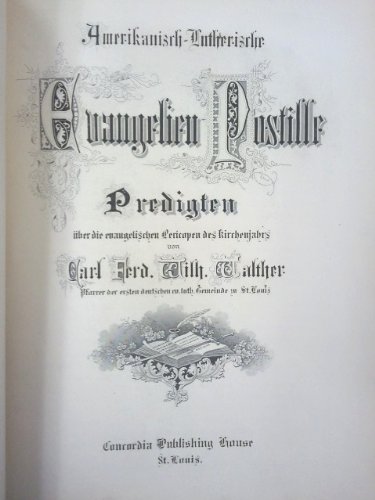
When I was on vicarage, I read this:


And it was one of the highlights of my entire "internship" year. 

No, I'm not THAT old! I was blessed with three boxes of "old German books" including and 1861 Latin all-in-one-volume Examination of the Council of Trent. Yet, I kept coming back to the Walther sermons on the Gospel readings of the Historic lectionary. Back then, my German was better than my Greek. It still meant slow going in Fraktur letters, but it was well worth my efforts (because I definitely needed some joyful, yet solvable distractions in those days).

I remember thinking aloud, "Why should English-reading LCMS Lutherans be deprived of reading these sermons of Walther?" Concordia Publishing House should be commended for making my wish a reality. It wasn't mine alone, apparently.

Walther's sermons reflect not only the importance of Walther as leading theologian of The Lutheran Church—Missouri Synod in the first decades of its existence but also his extraordinary gifts as a preacher. Now in English, Walther's sermons will give you today a peek into the powerful preaching of the first president of the LCMS.

The sermons are printed unchanged in content and form. They originate from the Walther's almost 30 years as pastor of the first German Evangelical Lutheran (Joint) congregation of the Unaltered Augsburg Confession in this country, which for some time past consists of four areas with four churches: Trinity, Immanuel, Zion, and Cross Churches. Gospel Sermons Volume 2 covers The Time of the Church (The Season after Pentecost, including sermons for several feast days).

Experience this explanation of God's Word by C. F. W. Walther and know that Christians are "a chosen race, a royal priesthood, a holy nation, a people for His [God's] own possession, that you may proclaim the excellencies of Him who called you out of darkness into His marvelous light" (1 Peter 2:9). This was the Bible verse Walther put on one of the first pages of the German edition of his Gospel sermons.

One of the most significant Lutheran theologians in North America, C. F. W. Walther (1811–87) dominated the theological landscape of the mid-1800s. A leader in the Saxon immigration to Missouri in 1839, Walther helped to found the college that would become Concordia Seminary, St. Louis, Missouri, as well as to organize The Lutheran Church—Missouri Synod. In addition to serving as a pastor, Walther was the synod's first president and the president of the seminary and its leading teacher. A prolific author, Walther wrote on a variety of topics, corresponded with numerous religious leaders, edited the theological journal Der Lutheraner, and helped start Concordia Publishing House.

If you haven't read more than Law and Gospel by Walther, you need to read these sermons. 

If you've never preached on the Historic One Year Lectionary (and you should for at least one year), consider doing so and prepare for the task by reading these Gospel Sermons. 

Any preacher would benefit from reading these sermons by consulting the Scripture Index of each volume to find texts found in both the One and Three-Year Lectionaries.

What does "postil" mean? Find the answer from President Harrison in his endorsement of the set.

My favorites were largely at the end of the second volume, "Day of the Purification of Mary" (234ff), "Reformation Day" (248ff), and "Day of Humiliation" (268f), though the first volume helped my preaching of Luke 18:31-43 on Quinquagesima (147ff) and John 14:23-31 for Pentecost (291ff).

Join the Walther's Works Subscription Program and Save!


What's next in Walther's Works? I haven't been told officially (or unofficially for that matter). 

Epistle sermons, anyone? 

His Communism and Socialism would be timely.


The Rev. Paul J Cain is Pastor of Immanuel Lutheran Church, Sheridan, Wyoming, Headmaster of Martin Luther Grammar School, Yellowstone Circuit Visitor (LCMS Wyoming District), a permanent member of the Board of Directors of The Consortium for Classical and Lutheran Education, Wyoming District Worship Chairman, and Editor of QBR. 


View article...