Thursday, December 6, 2018

Received for Review


Keating, Ray. Shifting Sands (A Pastor Stephen Grant Short Story). Manorville, NY: Keating Reports, 2018. 106 Pages. Paper. Kindle available.  http://www.pastorstephengrant.blogspot.com/


View article...

Faithful Fiction and Comfort under the Cross


Keating, Ray. Reagan Country (A Pastor Stephen Grant Novel). Manorville, NY: Keating Reports, 2018. 309 Pages. Paper. Kindle available.  http://www.pastorstephengrant.blogspot.com/ 

Keating, Ray. Heroes and Villains (A Pastor Stephen Grant Short Story). Manorville, NY: Keating Reports, 2018. 72 Pages. Paper. Kindle available.  http://www.pastorstephengrant.blogspot.com/

Arbo, Matthew. Foreword by Karen Swallow Prior. Walking through Infertility: Biblical, Theological, and Moral Counsel for Those Who Are Struggling. Wheaton: Crossway, 2018. 116 Pages. Paper. $15.99. www.crossway.org


I'm no snowflake. A faithful pastor cannot afford to be. Pastors and Christians face life and death issues frequently. We dare not hide our heads in the sand. We should face the difficult head-on, informed by Scripture, with faith in Christ, supporting one another with prayer and encouragement during cross-bearing.


The books in this review are different. The first books mentioned are fiction. The final titles are non-fiction. All deal with serious issues deftly thanks to the writing talents of their authors.


Our first novel visits the near-future of tomorrow's headlines. 


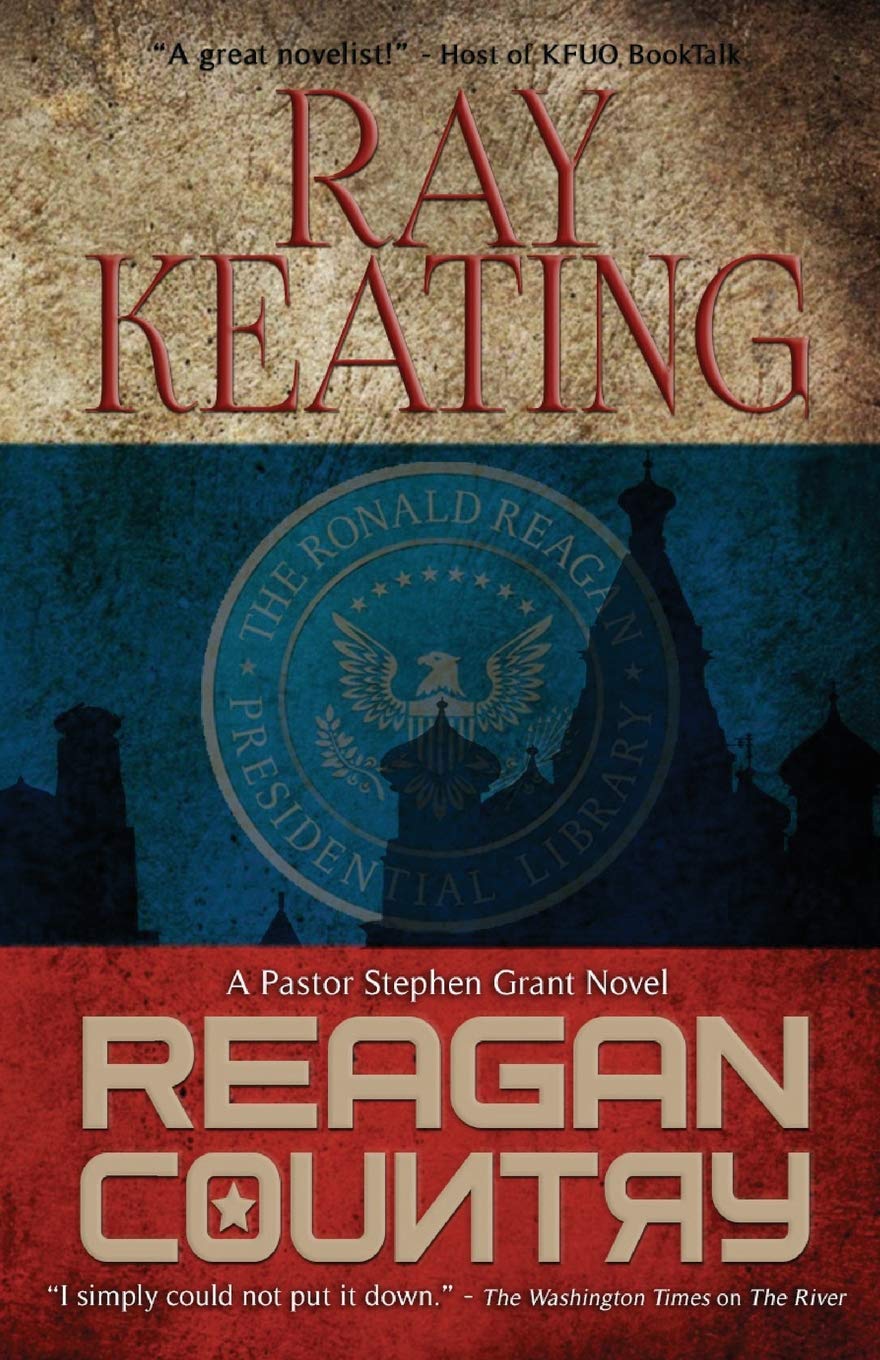
Reagan Country is the most-recent full-length novel in Ray Keating's Pastor Stephen Grant series. 

Please note the new cover style by the Rev. Tyrel Bramwell.


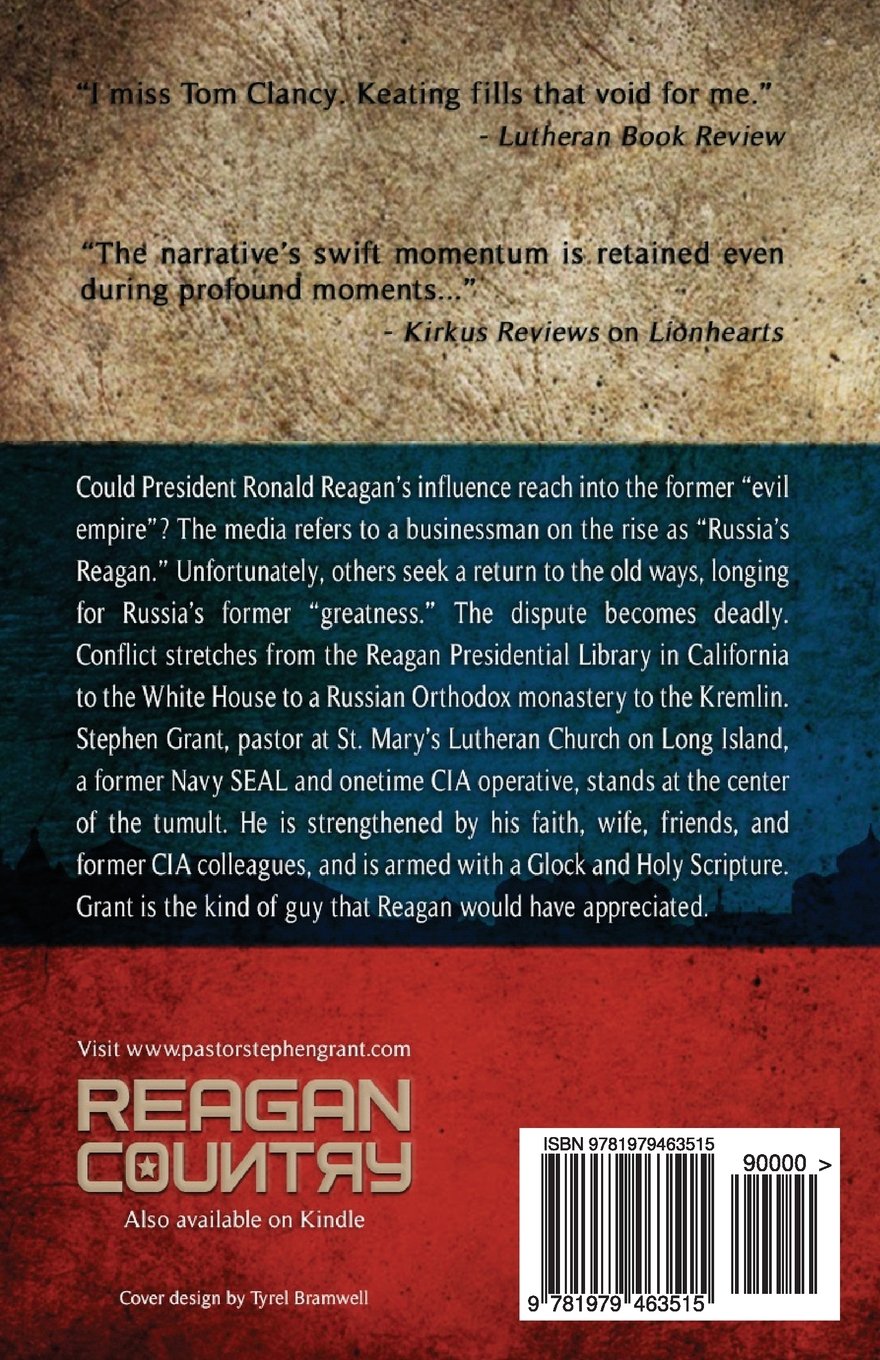
Could President Ronald Reagan's influence reach into the former "evil empire"? The media refers to a businessman on the rise as "Russia's Reagan." Unfortunately, others seek a return to the old ways, longing for Russia's former "greatness." The dispute becomes deadly. Conflict stretches from the Reagan Presidential Library in California to the White House to a Russian Orthodox monastery to the Kremlin. Stephen Grant, pastor at St. Mary's Lutheran Church on Long Island, a former Navy SEAL and onetime CIA operative, stands at the center of the tumult. He is strengthened by his faith, wife, friends, and former CIA colleagues, and is armed with a Glock and Holy Scripture. Grant is the kind of guy that Reagan would have appreciated. (Back cover)

Those who appreciate President Reagan may see this title and cover while browsing the many new books about our 40th President. Interest in the presidency is high given the contentious 2016 campaign, the recent death of President George H. W. Bush, and our nation's divided politics.

Reagan Country is a story of unexpected adventure. I have come to expect adventure for Rev. Stephen Grant in and beyond St. Mary's Lutheran Church (LCMS), but I did not expect this kind of plot. In an America where a large percentage of college students naiively prefer and/or promote socialism over capitalism, "Russia's Reagan" shows the promise of life, liberty, and the pursuit of happiness for the people who had been oppressed by socialism and communism. If only! 


My favorite part of this novel is the worldview of this eight-novel extended universe. We see everything in the context of pastors (don't forget St. Mary's Assistant) who confess Luther's Small Catechism and the Lutheran Confessions, active in Word and Sacrament ministry to real people, regular reference to Scripture, properly distinguished Law and Gospel, and glimpses into occasions of pastoral care and weekly liturgy (using Lutheran Service Book). Pastor Grant and the whole cast of Keating characters have to live with the consequences of their actions under the forgiveness of Christ. I know of no other author of thrillers that does this.

Reflecting on the series to date, one strength is the knowledge and research of the author. He becomes, if he is not already, a subject matter expert on the topic at hand. Reagan. Comic books. Wine. Baseball. Everything comes off as authentic, accurate, and well-informed.

Keating's creativity also avoids the formula of so much fiction in that we are not merely back to the "status quo" at the end of each installment. He develops characters, relationships, and situations in believable, realistic, human ways. We are primed, wanting more. 


And so I rejoice to share with you the coming of Stephen Grant short stories in addition to all the novels to date.


Heroes and Villains is the first (of hopefully many) Pastor Stephen Grant short stories.

As a onetime Navy SEAL, a former CIA operative and a pastor, many people call Stephen Grant a hero. At various times defending the Christian Church and the United States over the years, he has journeyed across the nation and around the world. But now Grant finds himself in an entirely unfamiliar setting – a comic book, science fiction and fantasy convention. But he still joins forces with a unique set of heroes in an attempt to foil a villainous plot against one of the all-time great comic book writers and artists.

Most pastors that I know have extensive libraries. I had the bug early. My comic book library has 10,000 volumes at last count. That covered my main period of collecting from 1986-1996, largely Superman and Batman plus the West Coast Avengers and Silver Surfer. Before superheroes, I read G. I. Joe. Before that, I apparently learned how to read with the help of Bugs Bunny and Uncle Scrooge, Scrooge McDuck, that is.

Heroes and Villains takes you inside all the drama of a comic convention, including that which only Stephen Grant can help with. It's an enjoyable romp complete with the gritty realism of the Burton Batman films, the camp of the Adam West adventures of the 60's, and the modern humor of LEGO Batman. 

If you know the adventures of the Avengers from the movies or the pages, dream of the day of decent DC films, or love the experience of Comic-Con, Heroes and Villains is the read for you! 

Gun-toting clergymen aren't only found in Wyoming. Keating's novels and short stories prove it with Pastor Stephen Grant and his adventures. May they continue! DC and Marvel are famous for telling stories of worlds like ours, yet different. This is the "multiverse." Somewhere, there is a world like ours where these stories have their own screen adaptations. How I'd love to see Pastor Grant on Netflix!

I love reading about a fictional Sheriff, Walt Longmire, while living in the region of Wyoming that inspired the fictional town and county in the novels of Craig Johnson. 

There is also a second series set in Wyoming, in another fictional town in another fictional county, about a fictional Game Warden, Joe Pickett, in the novels of C. J. Box. I am also a Lutheran pastor. It is an example of the embarrassment of riches that I also get to read about a fictional Lutheran pastor, Rev. Stephen Grant, 

through the keyboard and creative mind of Ray Keating. 


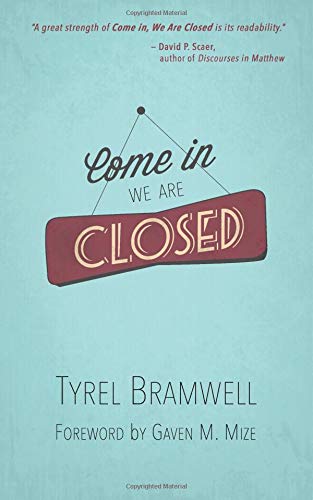
The cover designer of Keating's recent Stephen Grant titles of LCMS Pastor Tyrel Bramwell. His novel on the historic, Biblical, faithful, and apostolic practice of close(d) communion is called Come In, We Are Closed.


Many evangelicals are unfamiliar with it, don't understand it, and are often offended when they encounter it, but when it comes to the Lord's Supper the Scriptures clearly teach that Holy Communion is not for anybody and everybody. In this short work of fiction Rev. Tyrel Bramwell recalls the questions he had when he first encountered closed Communion as a young evangelical and the conversations he has had as a pastor, in order to dispel false assumptions and provide the Biblical answers to real misunderstandings.

It is a challenge to convey theological truth and faithful practice in fiction. The Rev. Tyrel Bramwell does so with theological deftness, pastoral winsomeness, and confessional faithfulness with regard to the challenging topic of Closed Communion. Engaging, humorous, and authentic, Come in, We Are Closed is the helpful tool laypeople and pastors have been praying for to reach those used to Open Communion. This book creatively and conversationally expands the limited number of Bible texts used to explain this faithful biblical practice within a fuller Lutheran confession of a Christian worldview and additional teaching on many other aspects of the Sacrament of the Altar. Come in, We Are Closed deals with Jesus' own words and how many react to them with unbelief instead of faith.


Another of our LCMS friends is Vanessa Rasanen, author of the first book in the Hearts on Guard series, Soldier On.


He's fighting for his country. She's praying for his safety. When tragedy strikes, can their marriage and faith survive?

Charlie and Meg Winters are no strangers to the military life and the challenges it brings. But when an IED rips through his convoy killing his friends, the loss proves almost too much to bear.

Meg finds her trust in Christ wavering, and secrets she's been keeping for years drive a wedge between her and her husband.

What if everything Meg believes is a lie?

What if Charlie finds out what she's done?

Can Meg and Charlie save their marriage or will the horrors of war and the ghosts of their past tear them apart and forever shipwreck her faith?

Soldier On is a gripping contemporary women's fiction novel. If you like inspirational stories of faith tested under pressure, then you'll love Vanessa Rasanen's true-to-life novel.

Like the books by Keating and Bramwell above, Rasanen's debut novel is realistic, grounded, and authentic, and delivers true comfort in Christ because it deals with difficult topics in all of their gritty agony. This is Law and Gospel, properly distinguished, applied to life. A military couple deals with their vocations as Lutheran Christians, sinners and saints, complete with Scripture, prayer, Luther's Small Catechism, and church services with Lutheran Service Book.


I recommend all the fiction titles above because they help the reader deal with difficult topics, like the following nonfiction title, Walking Through Infertility.


Walking through Infertility: Biblical, Theological, and Moral Counsel for Those Who Are Struggling

By Matthew Arbo, Foreword by Karen Swallow Prior  

"This book was written to help you see and understand that God is the Giver of life. You are his child. He cares deeply about you. When you hurt, he hurts with you." —from the Introduction


Infertility is the profoundly wounding experience of many couples, often leading to feelings of despair and shame as they grapple with shattered dreams and unanswered questions. But God does not leave them alone in their pain. The Creator and Redeemer of life has not forsaken the infertile, but has called and equipped them to participate in his church, kingdom, and mission.

Overflowing with warmth and sensitivity, this book explores what the Bible says about infertility, helping the church walk alongside couples struggling with infertility and assessing the ethical issues surrounding common fertility treatments and reproductive technologies.

(Publisher's Website)

Among the practical helps of this volume are moral assessments of therapies and treatments recommended to couples (20), the comforting truth that childlessness is not a punitive judgment (41), encouragement toward contentment as a child of God (59), comfort in Christ in the Church, a family (73).

I found this title to be of good Christological comfort, by an informed, compassionate author.


Even so, I found the following two titles to be more specifically theologically and practically helpful for Lutheran Christians.  


He Remembers the Barren is a title from Emmanuel Press, now in its Second Edition. It is not just a book for women. See our review of the First Edition.

He Remembers the Barren is a tender conversation with women in the church who wrestle with the issue of barrenness in marriage. Addressing questions frequently asked by those struggling with infertility, Schuermann examines the source of conception, control of our bodies, family planning, and adoption through the lens of the theology of the cross, always pointing the reader to her identity in Christ.

This revised and expanded second edition boldly confesses the author's growing understanding of barrenness and related life issues. With Psalm readings, beloved hymn texts, and prayers at the conclusion of each chapter, He Remembers the Barren resonates on a devotional level that offers comfort not only to those who ache under the cross of barrenness, but to anyone who knows the grief and shame of suffering. It is a valuable resource for family members, friends, pastors, and anyone seeking to better understand and empathize with the childless experience of a loved one. Schuermann gives voice to those who are barren but not broken, drawing the reader away from the temptation to despair and always bringing the focus back to the Gospel and the peace that only Christ can give. (Back cover)


Concordia Publishing has recently released Never Forsaken.

Many women don't talk about miscarriages. They feel a heavy weight of sadness, shame, and fear. And yet, many women close to them - sisters, mothers, friends, coworkers, neighbors - experience the same silent grief.
Author Kathryn Ziegler Weber wants to break the silence about miscarriage. Through vignettes from real women, she and the brave women who shared their stories bring God's Word into reader's unspoken story of grief, providing comfort and reassurance.

Answering questions like "What if my baby wasn't baptized?" and "Why doesn't my husband understand?", Never Forsaken wiill give comfort to grieving mothers and understanding to those who haven't experienced miscarriage themselves. (Publisher summary)


Even though we've been using LSB for long enough that it is old enough for confirmation classes, I still remember the Janzow translation of Gerhardt's hymn of cross and comfort from LW 423:2, where the Christian is speaking and praying to the Lord: 

Under burdens of cross-bearing,
Though the weight
May be great,
Yet I'm not despairing.
You designed the cross you gave me;
Thus you know
All my woe
And how best to save me
.

Amen.


This review (and others published near it in time) was delayed because of family and congregational vocational responsibilities. I apologize for the delay. 


Rev. Paul J Cain is Senior Pastor of Immanuel, Sheridan, Wyoming, Headmaster of Martin Luther Grammar School and Immanuel Academy, a member of the Board of Directors of the Consortium for Classical Lutheran Education, Secretary of the Wyoming District of The Lutheran Church-Missouri Synod and a member of its Board of Directors, Wyoming District Education Chairman/NLSA Commissioner, and Editor of Lutheran Book Review. He has served as an LCMS Circuit Visitor, District Worship Chairman and District Evangelism Chairman. A graduate of the University of Nebraska-Lincoln and Concordia Seminary, St. Louis, Rev. Cain is a contributor to Lutheran Service Book, Lutheranism 101, the forthcoming LSB Hymnal Companion volumes, and is the author of 5 Things You Can Do to Make Our Congregation a Caring Church. He is an occasional guest on KFUO radio. He has previously served Emmanuel, Green River, WY and Trinity, Morrill, NE. Rev. Cain is married to Ann and loves reading and listening to, composing, and making music. 


View article...

Bernard of Clairvaux and an Expository Commentary for Preachers


Posset, Franz. Pater Bernhardus: Martin Luther and Bernard of Clairvaux (Collected Works Volume 2). Eugene: Wipf and Stock, 2018. Paper. $47.00 (Discounts available.) https://wipfandstock.com/catalogsearch/result/?q=posset


Duguid, Iain M., James M. Hamilton, Jr., and Jay Sklar, Editors. ESV Expository Commentary (Volume VII, Daniel-Malachi). Wheaton: Crossway, 2018. 795 Pages. Cloth. $50.00. www.crossway.org


Duguid, Iain M., James M. Hamilton, Jr., and Jay Sklar, Editors. ESV Expository Commentary (Volume XI, Ephesians-Philemon). Wheaton: Crossway, 2018. 567 Pages. Cloth. $40.00. www.crossway.org


Duguid, Iain M., James M. Hamilton, Jr., and Jay Sklar, Editors. ESV Expository Commentary (Volume XII, Hebrews-Revelation). Wheaton: Crossway, 2018. 784 Pages. Cloth. $45.00. www.crossway.org


The resources presented in this review have in common a respect for the Word of God as the Word of God. 


Three volumes of the new ESV Expository Commentary equip a preacher to explain the Word in preaching and teaching. Pater Bernhardus demonstrates the connection between the Reformer himself and one viewed by some as a forerunner of the Reformation. Luther appreciated Bernard's writings, especially his sermons, which clearly present Christ.


The publication of the Christian Book of Concord in the 1580 German edition included an appendix, the Catalog of Testimonies, which was not a formal part of the Lutheran Confessions. It is important to Lutherans and has been widely used because it provides additional evidence for the Lutheran position on the doctrine of the two natures in Christ. Scripture passages and quotations from church fathers on the person of Christ are cited, with a special focus on the fact that because of the Incarnation the human nature of Christ shares in the qualities of divinity. Why share quotations from church fathers? It showed that the Lutheran positions on the two natures in Christ and the Sacrament of the Altar were not newly-invented or ahistorical, but Biblical, having been confessed by fathers faithful to the Scriptures centuries before. (Condensed and restated from http://bookofconcord.org/testimonies.php)

Bernhard of Clairvaux is not quoted in the Catalog of Testimonies, but he was well known to Martin Luther through his writings. One notes that Luther was quite familiar with Pater Bernhardus, a theologian Luther respected as he did Augustine.


Franz Posset is a German-American independent church historian and lay theologian in the Catholic Church. He is an internationally recognized ecumenist, specializing in the history and theology of the Renaissance and early Lutheran Reformation. Franz was born in 1945 in Glockelberg in the Bohemian Forest (Sudetenland), and between 1965 and 1970 he was a student of Hans Kung, Josef Ratzinger (Pope Benedict XVI emeritus), and Walter Kasper (Cardinal). He earned a diploma in Catholic theology at University of Tubingen, and received a PhD in Religious Studies, with his dissertation directed by the late Kenneth Hagen, at Marquette University in Milwaukee, WI. He was the associate editor of Luther Digest (1993-2012) and is a member of the International Luther Society. Franz is the author of numerous articles and books in English and German including award-winning articles and books: - The first annual Natalie Zemon Davis Prize (Canada) in 2006 for his ""Polyglot Humanism in Germany circa 1520 as Luther's Milieu and Matrix."" - Davidias Prize of the Association of Croatian Writers in 2014 for the book, Marcus Marulus and the Biblia Latina of 1489. - Franz-Delitzsch-Forderpreis (Germany) in 2015 for his ""In Search of an Explanation for the Suffering of the Jews: Johann Reuchlin's Open Letter of 1505."" - The Koenig Prize in Biography of the American Catholic Historical Association in 2016 for the book, Johann Reuchlin (1455-1522): A Theological Biography.(Publisher's Website)

This volume, now included as the second volume of the Collected Works of Franz Posset, was originally published in 1999 by Cistercian Publications. This 2018 Wipf & Stock edition features a new Introduction by the author and two pages of Corrigenda. Regarding the latter (4), perhaps the very first correction, "p. 6," should be corrected. It appears to refer to second page of the Table of Contents, giving the correct page numbers for 'On Consideration' (353) and 'Triple Feeding' (366) [not "Tripe"]. I do not wish one line in the book distract you from its overall importance. What is the connection between Bernard and Martin Luther? Consider this photo of my copy of the back cover of the 1999 edition:


The cover art of both editions features a photograph of a sculpture of Christ embracing both men.


This volume is significant in part because a lay Roman Catholic theologian was willing to fairly examine Martin Luther.  Posset is also the author of The Real Luther: A Friar at Erfurt and Wittenberg, published by Concordia, a Lutheran publishing house, that of The Lutheran Church-Missouri Synod. His work has always reminded me of that of Fr. Frank Olivier, an Assumptionist Father, who was Professor of Lutheran studies at the Institut Superior d'Etudes Oecumeniques  at Paris when his book The Trial of Luther (Concordia, translated by John Tonkin) was published in 1978 and Professor of Theology at the Catholic University in Paris when Luther's Faith: The Cause of the Gospel in the Church (Concordia, translated by John Tonkin) was published in 1982. The latter was a seminary textbook for me. Finding the former was a quest. Both authors are fair-minded and scholarly. All these volumes deserve to share a shelf.


Posset notes that Martin Luther read and quoted Bernard of Clairvaux throughout his life. The "Cistercian Cicero" was a part of Luther's theological formation, homiletical formation, and pastoral formation. This is a book that deserves time to digest, ponder, and absorb as he makes his case that Bernard informed Luther's view of monasticism, grace alone, faith alone, Christ alone, and what C. F. W. Walther would describe as a theology where the Gospel (in its narrow sense) predominates.


Luther will disagree with Father Bernard on "monastic stuff" (to borrow a phrase from Posset), the interpretation of Psalm 90, aspects of Bernard's teaching of Christ as Judge, and when he emphasizes the mother of our Lord more than our Lord.

This volume will introduce Lutherans to Bernard through Luther and Catholics to Luther via Bernard. Readers may be intrigued enough to read more, whether Luther's Works (American Edition), Some Letters of Saint Bernard, Sermons for Lent and the Easter Season, or Lane's Bernard of Clairvaux: Theologian of the Cross.


Recommended? Yes. We are also interested in the first and third volumes of the works of Franz Posset as published by Wipf & Stock, The Two-Fold Knowledge: Readings on the Knowledge of Self and the Knowledge of God Selected and Translated from the Works of Saint Bernard of Clairvaux (Collected Works Volume 1) and Luther's Catholic Christology According to His Johannine Lectures of 1527 (Collected Works Volume 3).


Luther is the Bible commentator par excellence, largely because of his pastoral and homiletical approach. He wishes to present Christ. I appreciate good Bible commentaries, in part, because there are so many unhelpful ones from a confessional Lutheran perspective. Far too many push an agenda, practicing eisegesis rather than exegeting the Bible text. The ESV Expository Commentary is new. There are currently only three of the projected twelve volumes in print. They are our other subject in this review.

Designed to strengthen the global church with a widely accessible, theologically sound, and pastorally wise resource for understanding and applying the overarching storyline of the Bible, this commentary series features the full text of the ESV Bible passage by passage, with crisp and theologically rich exposition and application. Editors Iain M. Duguid, James M. Hamilton, and Jay A. Sklar have gathered a team of experienced pastor-theologians to provide a new generation of pastors and other teachers of the Bible around the world with a globally minded commentary series rich in biblical theology and broadly Reformed doctrine, making the message of redemption found in all of Scripture clear and available to all.

Honestly, I cringed a little at the phrase "broadly Reformed doctrine" being a Lutheran, but I find the volumes I've seen so far to be fair and "rich in biblical theology." (Perhaps a small "r"? Either way, the word is preferable to how "protestant" is now (mis)used generally. My concern is more in the realm of future marketing than actual offense.) These three volumes are practical tools for preaching while also being substantive. I want to see the whole set!

ESV Expository Commentary: Daniel–Malachi

Volume 7

Series edited by Iain M. Duguid, James M. Hamilton Jr., Jay Sklar

Thirteen contributors explain the shorter Prophetic Books of the Old Testament—Daniel, Hosea, Joel, Amos, Obadiah, Jonah, Micah, Nahum, Habakkuk, Zephaniah, Haggai, Zechariah, and Malachi—with biblical insight and pastoral wisdom, showing readers the hope that is offered even amidst judgment.

Contributors include:
Mitchell L.  Chase
George Schwab
Allan M. Harman
Michael G. McKelvey
Max Rogland
Jay Sklar
Stephen J. Dempster
Daniel Timmer
David G. Firth
Jason S. DeRouchie
Michael Stead
Anthony R.  Petterson
Eric Ortlund

A Major Prophet joins the Twelve so-called Minor Prophets in Volume VII. It features an abundance of tables, a helpful teaching tool for Daniel primarily, but also for Hosea and Jonah. Daniel 12:1-3 was a recent Series B lectionary text. It is here helpfully combined with Daniel 11:2ff. The text is daunting to a preacher. The commentary is quite comprehensive, yet focused and helpful.

The end of the commentary on Jonah is pointed law: "if we are in any way selective in terms of the people to whom we show God's grace, mercy, love, and forgiveness, then we still do not get it. We remain disciples of Jonah, not disciples of Jesus" (421). 


Commentary on Habakkuk 2:2-4 highlights "by faith" as "a life lived in dependence on God" and "faithfulness," "a recognition of God's trustworthiness, even when circumstances are challenging" (545, cf. Hebrews). 

Commentary on Zechariah 6:13 highlights the "conceptual background" of Psalm 110 for interpretation of the Branch, Christ, as Priest. 

Commentary on Malachi 3:6-12 fairly shows the "stewardship" sermon of the prophet here, yet places it in the context of no "exact amount" for the NT church.

The goal I hope to see in any Old Testament commentary is that of preaching Christ. I was not disappointed. 

ESV Expository Commentary: Ephesians–Philemon

Volume 11

With contributions from a team of pastors and scholars, this commentary through 9 of Paul's letters helps students of the Bible to understand how each epistle fits in with the storyline of Scripture and applies today.

Contributors include:

Benjamin L. Merkle
Jason C. Meyer
Alistair I. Wilson
David W. Chapman
Denny Burk
Alistair I. Wilson

Highlights in this volume include exposition of Ephesians 2:8-10. It notes that the antecedent of "this" is the whole phrase before. "God not only saves us from our sin; he also saves us for good works. Paul is absolutely clear that good works do not save a person. However, he does maintaining that God calls all believers to a virtuous life" (47, italics original). 

I would urge reading Colossians 2:12 in conjunction with Romans 6. The commentator's reference to "mode of baptism" notes his bias, yet in saying as much has he does connecting circumcision to baptism as Paul does is more than I have heard from many of his confession.


Regarding 1 Thessalonians 4:17, the commentator notes: "There are difficulties in 1 Thessalonians for the rapture theory" (301). Yes. This is a polite yet clear theological smackdown of a false idea originating in an 1830's Scottish fringe group.


Commentators support morality and ministry as presented in the pastoral epistles.

ESV Expository Commentary: Hebrews–Revelation

Volume 12

Six experienced Bible teachers walk through some of the richest but more challenging books of the New Testament, helping Bible readers understand what they say about Christians' hope for the future.

Contributors include:
Dennis E. Johnson
Robert L. Plummer
C. Samuel Storms
Ray Van Neste
Matthew S. Harmon
Thomas R. Schreiner


(Publisher's Website)

I received these three volumes in October. As expository commentaries, they are designed to prepare a pastor for preaching. And so they did. Given the readings in Series B of the Three-Year Lectionary from Lutheran Service Book, the bulk of my attention was given to volume XIII, covering Hebrews through Revelation.

I then read through the commentary focusing on pericopes past and present:

Hebrews 2:1-13 (14-18)

Hebrews 3:12-19

Hebrews 4:1-13 (14-16)

Revelation 14:6-7

Revelation 7: (2-8) 9-17

Hebrews 9: 24-28

Hebrews 10:11-25

Jude 20-25

Revelation 1:4b-8


I had the opportunity to evaluate recent sermons on the first texts on the list on the basis of the scholarship and homiletical insights of volume XIII. I then was able use the volume to better prepare for preaching on the rest.


When you serve in one congregation for multiple cycles through the lectionary (whether Three-Year or Historic One Year), preachers can feel stagnant or unappreciated. We don't preach for the sake of feedback or praise (Galatians 1), though genuine encouragement for the right reasons and authentic constructive criticism in the right spirit is helpful (Galatians 6:6). That said, since I've been preparing for sermons by reading these commentaries, I've received more positive feedback on my preaching, both those with manuscripts and those without. You're mileage may vary, but I am encouraged.


Historic One-Year Lectionary preachers and Three-Year Lectionary preachers will benefit from all projected volumes every year. Three-Year Lectionary preachers may also note the following:

  • VII, Daniel-Malachi: particularly helpful for Holy Week and the Easter Season
  • XI, Ephesians-Philemon: particularly helpful in Series C (Advent 2018, 2021, etc)
  • XII, Hebrews-Revelation: particularly helpful for feasts, festivals, and occasions

Individual authors do occasionally show their biases and those of their specific theological tradition. I find respectful presentation of views throughout, in a way that is an improvement upon the commentary of the original ESV Study Bible. (I have yet to see volumes covering Matthew 16 and 1 Corinthians 11, but call me optimistic for now.) The discussion of the Thousand Years (Revelation 20:1-6; pp. 723ff) is illustrative. The author, as do I, has the amillennial view, yet he fairly explains postmillenial and premillenial views. Such an approach allows all sides to deal with 1) the actual text, 2) actual theological positions instead of caricatures, and 3) be confronted with Biblical evidence explained honestly, clearly, and pastorally. Only the Holy Spirit can change hearts and minds. This approach helps get preference, opinion, and ego out of the way. 

References include Concordia Commentary in volume XIII. That is positive for me and our readers. There are no known Lutheran contributors to the series that we are aware of (yet). 


Six Old Testament volumes (I through VI) covering Genesis-Ezekiel will join VII, Daniel-Malachi. VIII, IX, and X will cover the New Testament, Matthew-Galatians. 

Keep up your Greek and Hebrew work, read Pieper and the Book of Concord, and your most reliable commentaries as you usually do. And then read about the pericope at hand in the ESV Expository Commentary.

Yes, this set would be worth the money to buy, the time to read and study, the shelf space to store, and would be very helpful in preaching and teaching. Recommended!


ESV Expository Commentary Series from Crossway on Vimeo.

Rev. Paul J Cain is Senior Pastor of Immanuel, Sheridan, Wyoming, Headmaster of Martin Luther Grammar School and Immanuel Academy, a member of the Board of Directors of the Consortium for Classical Lutheran Education, Secretary of the Wyoming District of The Lutheran Church-Missouri Synod and a member of its Board of Directors, Wyoming District Education Chairman/NLSA Commissioner, and Editor of Lutheran Book Review. He has served as an LCMS Circuit Visitor, District Worship Chairman and District Evangelism Chairman. A graduate of the University of Nebraska-Lincoln and Concordia Seminary, St. Louis, Rev. Cain is a contributor to Lutheran Service Book, Lutheranism 101, the forthcoming LSB Hymnal Companion volumes, and is the author of 5 Things You Can Do to Make Our Congregation a Caring Church. He is an occasional guest on KFUO radio. He has previously served Emmanuel, Green River, WY and Trinity, Morrill, NE. Rev. Cain is married to Ann and loves reading and listening to, composing, and making music. 


View article...

Received for Review


Posset, Franz. Pater Bernhardus: Martin Luther and Bernard of Clairvaux (Collected Works Volume 2). Eugene: Wipf and Stock, 2018. Paper. $47.00 (Discounts available.) https://wipfandstock.com/catalogsearch/result/?q=posset


View article...

Friday, October 19, 2018

Received for Review


Duguid, Iain M., James M. Hamilton, Jr., and Jay Sklar, Editors. ESV Expository Commentary (Volume VII, Daniel-Malachi). Wheaton: Crossway, 2018. 795 Pages. Cloth. $50.00. www.crossway.org 

Duguid, Iain M., James M. Hamilton, Jr., and Jay Sklar, Editors. ESV Expository Commentary (Volume XI, Ephesians-Philemon). Wheaton: Crossway, 2018. 567 Pages. Cloth. $40.00. www.crossway.org 

Duguid, Iain M., James M. Hamilton, Jr., and Jay Sklar, Editors. ESV Expository Commentary (Volume XII, Hebrews-Revelation). Wheaton: Crossway, 2018. 784 Pages. Cloth. $45.00. www.crossway.org 


View article...

Monday, July 30, 2018

Received for Review


Arbo, Matthew. Foreword by Karen Swallow Prior. Walking through Infertility: Biblical, Theological, and Moral Counsel for Those Who Are Struggling. Wheaton: Crossway, 2018. 116 Pages. Paper. $15.99. www.crossway.org


View article...

Wednesday, June 6, 2018

Received for Review


Cressman, Lisa. Foreword by Gregory Heille. Backstory Preaching: Integrating Life, Spirituality, and Craft. Collegeville: Liturgical Press, 2018. 158 Pages. Paper. www.litpress.org (UN)

Note: Due to time constraints, we are not able to review every unsolicited title we receive. We urge publishers to contact us before submitting unsolicited titles for review.


View article...

Tuesday, May 15, 2018

Received for Review


Gilbert, Richard, F.C.A. The Nicene Creed According to the Scriptures. New Reformation Press. Trifold Pamphlet. www.newreformationpress.com


Locklair, Valerie. Called to Defend: An Apologetics Handbook for the Middle School Student. New Reformation Press. Cloth. 249 Pages. www.newreformationpress.com


Giertz, Bo. Translated by Bror Erickson. Romans: A Devotional Commentary (Excerpted from the New Testament Devotional Commentaries Series). New Reformation Press. 97 Pages. Paper. www.newreformationpress.com  www.1517legacy.com


Keith, Scott. Meeting Melanchthon: A Brief Biographical Sketch of Phillip Melanchthon and a Few Examples of His Writing.  New Reformation Press. 87 Pages. Paper. www.newreformationpress.com  www.1517legacy.com


View article...

Monday, May 14, 2018

Received for Review


Manetsch, Scott M., Editor. Timothy George, General Editor. Scott M. Manetsch, Associate General Editor. 1 Corinthians (Reformation Commentary on Scripture, New Testament IXa). Downers Grove, IL: IVP Academic, 2017. 508 Pages. Cloth. $60.00. https://www.ivpress.com/1-corinthians-rcs (P)


George, Timothy. Reading Scripture with the Reformers. Downers Grove, IL: IVP Academic, 2011. 270 Pages. Paper. $18.00. https://www.ivpress.com/reading-scripture-with-the-reformers (P)


Hall, Christopher A. Living Wisely with the Church Fathers. Downers Grove, IL: IVP Academic, 2017. 274 Pages. Paper. $24.00. https://www.ivpress.com/living-wisely-with-the-church-fathers


Crosby, Cindy, Editor. General Editor Thomas C. Oden, General Editor. Ancient Christian Devotional: A Year of Weekly Readings, Lectionary Cycle A. Downers Grove, IL: IVP Academic, 2007. 294 Pages. Paper. $20.00. https://www.ivpress.com/ancient-christian-devotional-lectionary-cycle-a 


Crosby, Cindy, Editor. General Editor Thomas C. Oden, General Editor. Ancient Christian Devotional: A Year of Weekly Readings, Lectionary Cycle B. Downers Grove, IL: IVP Academic, 2011. 303 Pages. Paper. $20.00. https://www.ivpress.com/ancient-christian-devotional-lectionary-cycle-b 


Crosby, Cindy, Editor. General Editor Thomas C. Oden, General Editor. Ancient Christian Devotional: A Year of Weekly Readings, Lectionary Cycle C. Downers Grove, IL: IVP Academic, 2009. 304 Pages. Paper. $20.00. https://www.ivpress.com/ancient-christian-devotional-lectionary-cycle-c


View article...

Tuesday, May 8, 2018

Lutheran Book Review: The Cross Proclaimed and Endured


Kellemen, Bob. Counseling under the Cross: How Martin Luther Applied the Gospel to Daily Life. Greensboro: New Growth Press, 2017. Paper. 246 Pages. $19.99. http://stores.newgrowthpress.com/counseling-under-the-cross/


Selderhuis, Herman. Martin Luther: A Spiritual Biography. Wheaton: Crossway, 2017. ADVANCE READER COPY received. Final Cloth edition received. 320 Pages, $35.00. https://www.crossway.org/books/martin-luther-hcj/


Six months after 31 October 2017, the Reformation of Martin Luther lives on!


We previous read counseling advice from Bob Kellemen in the brief book on anxiety.

Now he turns his attention to mining Luther for help in pastoral counseling.

Martin Luther was not only a theologian, a writer, and a preacher, he was a pastoral counselor who longed for peace with God. Now, 500 years after he posted his 95 theses to the door of the Wittenberg Castle church, his teachings on gospel-centered and cross-focused pastoral care can transform our approach to soul care, and teach us that daring faith in Christ alone can change our life today and give us peace forever.


In Counseling Under the Cross, biblical counselor and noted author Bob Kellemen mines the riches of Luther's letters of spiritual counsel to give readers a new understanding of how Luther engaged in the personal ministry of the gospel. He guides pastors, counselors, lay leaders, and friends toward a deeper understanding of the gospel that will directly impact their personal ministry to others. Through lively vignettes, real-life stories, and direct quotes from Luther, readers will be equipped to apply the gospel to themselves and others, and learn that pastoral care is what every believer does in one-another ministry.

As one of the most influential figures in Christian history, Luther was not only the father of the Reformation, he was also the father of "gospel-centered counseling." As sons and daughters in the faith, we have much to learn from him. Counseling Under the Cross equips us to apply the gospel richly, relevantly, and robustly to suffering and sin so that we find our hope and help in Christ alone.

Author
Bob Kellemen, PhD, is the Vice President for Institutional Advancement and Chair of the Biblical Counseling Department at Crossroads Bible College and the founder and CEO of RPM Ministries. He is the author of many books, including Counseling Under the Cross: How Martin Luther Applied the Gospel to Daily Life, Gospel-Centered Counseling and Gospel Conversations. Bob and his wife Shirley have two children and two grandchildren.
(Publisher's Website)

Upon receiving Counseling Under the Cross, the author's name seemed familiar. I personally purchased Robert Kellemen's Anxiety: Anatomy and Cure, a booklet that is part of P&R's The Gospel for Real Life Series. It was helpful to me in some recent pastoral counseling cases. New Growth Press gives us a title reminiscent of Tappert's Luther: Letters of Spiritual Counsel, yet with more guidance for pastors and counselors. 


I do disagree with the author's "Tweet-Size Summary" of Chapter 11: "Faith Active in Love: Luther's Methodology of Guiding >> Christian pilgrims progress in their sanctification journey by exercising their heart in the gospel victory narrative by trekking toward the gospel pole of faith active in love." Luther wouldn't speak that way. He would describe sanctification in the language of vocation as he does in Christian Freedom: A Christian is the freest lord of all, subject to none. A Christian is the most dutiful servant of all, subject to all. The "pilgrim" language is anachronistic to Luther. The author does mention The Freedom of a Christian in the main text of Chapter 11 (199ff), yet with a different emphasis than I would provide as a Lutheran. 


Given the objection above, I recommend this title for seminarians and pastors. Consider: "As the title of this book suggests, Martin Luther's counseling is gospel-centered and cross-focused. It is grace-filled and gospel-rich…In a hundred different ways you will see what I saw—Luther richly, relevantly, robustly, relationally applying the gospel to suffering, sin, sanctification, and people's search for peace with God" (3). On pages 12-13 he introduces the helpful concept of Anfectungen, helpfully connecting the term to Luther's own concerns and pastoral care, especially with regard to justification and reconciliation (26). By pages 106 and 107, Anfectungen makes room for faith in Christ. The Gospel predominates in the chart on page 57. A Lutheran would connect the individual to the body of Christ as the author does (91), yet more so to Word and Sacrament of Christ rather than pietism's small groups (91ff). 

Luther ended like he began—with Christ's gospel of grace. He sandwiched gospel indicatives around gospel imperatives. When Satan tempts us to despair, we do not look ultimately to our self, but ultimately and always to Christ: "When the devil casts up to us our sin, and declares us worthy of death and hell, we must say: 'I confess that I am worthy of death and hell. What more do you have to say?' 'Then you will be lost forever!' 'Not in the least: for I know One who suffered for me and made satisfaction for my sins, and his name is Jesus Christ, the Son of God. So long as he shall live, I shall live also' (194).


We now turn from Luther quoted and applied to today to Luther explained for today in an English translation of a major Danish biography.

Famous for setting in motion the Protestant Reformation, Martin Luther is often lifted high as a hero or condemned as a rebel. But underneath it all, he was a man of flesh and blood, with a deep longing to live for God.


This biography by respected Reformation scholar Herman Selderhuis captures Luther in his original context and follows him on his spiritual journey, from childhood through the Reformation to his influential later years. Combining Luther's own words with engaging narrative designed to draw the reader into Luther's world, this spiritual biography brings to life the complex and dynamic personality that forever changed the history of the church.


Herman Selderhuis is professor of church history at the Theological University Apeldoorn in the Netherlands and director of Refo500, the international platform focused on raising awareness for projects related to the legacy of the Reformation. He also serves as the director of the Reformation Research Consortium, president of the International Calvin Congress, and curator of research at the John à Lasco Library in Emden, Germany. He is the author or editor of several books, including John Calvin: A Pilgrim's Life. (Publisher's Website)


Crossway provided us with both an Advance Reader Copy and final hardcover of Herman Selderhuis' Martin Luther: A Spiritual Biography. We note no significant changes between the two. Endorsements adorn the front pages of the final edition as well as the intended General Index and Scripture Index.


What exactly is a spiritual biography? I understand the term to focus the subject's life in Christ, covering struggle, theology, practice, and consolation. A Calvinist, Selderhuis gives his own spin on the seventeenth century English non-fiction prose genre of an autobiographical narrative that "follows the believer from a state of damnation to a state of grace." Ten chapters follow Luther from child, student, and monk to exegete, theologian, and architect and finally reformer, father, professor, and prophet (9). "This book is translated from the original Dutch version" © 2016 (8).


"The fear of being lost forever, the fear of God, and his consciousness of sin and guilt led to a zealous study of Scripture in the hope that he [Luther] would find peace and rest" (54). This is well stated. Luther's visit to Rome disappointed him (71). Romans, however, became "the most important book in the new testament for him" (77). 


I'm not surprised that it was a Roman Catholic that claimed that Luther didn't nail the 95 Theses to the Church door (100). I am surprised at how trendy it is to doubt this event. This author tends to be more fair and balanced in his assessment of the event in that he allows for 1) an actual "nailing" of Luther's Theses, 2) that the door was truly the public bulletin board, and 3) that a university "beadle" likely did the nailing rather than Luther. That said, I hold to the historicity of Luther nailing the theses himself. There appears to be a correlation (among self-described Lutheran theologians) between belief or doubt in the event's historicity and in belief or doubt in authority and sufficiency of Scripture (see the 2017 documentary film Martin Luther: The Idea that Changed the World).

For a personal assessment of Luther the man at the time of the Leipzig Disputation by Mosellanus, see 128-129. The initial sentence of Chapter 6 (135) struck me wrong. Yet, I concede that with regard to being and architect and leaving it "to others to build on what he established" I must concede as at least partially true. He wrote his catechisms (230) in part because others did not follow through on his request for them to do the work. Some took up the task of writing new hymns, yet Luther wrote several dozen himself 210).


That Luther did or did not say the words "Here I stand, I can do no other" (159ff) is less controversial to me than the posting of the 95 Theses. Rome had pushed Luther across a red line. They would not tell him where he erred. They would not allow him to distinguish between what he saw as three groups of books. 


The author's account and assessment of Marburg (especially 238-240) is more fair than most from a Lutheran perspective. My favorite remains This Is My Body by Sasse. It all should come down to faith rather than doubt or speculation about what Christ said Himself.


Reform of the Sacrament of the Altar went hand-in-hand with a German translation of the New Testament (170ff). One of my favorite paintings depicts this time in his life, with Luther, his family, and Melanchthon gathered around Luther playing a lute (211). 


Professor Luther knew Scripture and how to apply it to life. (251). "Prophet" Luther (Chapter 10) is a bit more jarring picture, even for Lutherans who have heard Walther interpret Revelation's Angel with an Eternal Gospel to proclaim. We Lutherans are far more familiar with the pattern set by Luther in ordaining the first Lutheran bishop: "Luther conducted this ordination but with a transformed ritual that reflected Luther's views of the bishop as a normal minister. Everything else remained the same, as if the bishop carried out his work of supervision, pastorate, and preaching" (297).


This is one of the best recent Luther biographies I've read. I'm still stuck in the middle of the Metaxas volume. It would be nearly impossible for one person to read them all!


The Lutheran Reformation lives on. Our intent was to complete and publish this review by the 500th Anniversary of the posting of the 95 Theses, but parish duties intervened. We had twelve deaths in the congregation between our reception of the ARC and the day I write. Reform of the Church, returning to the Word as sole authority for faith and life, and hearing Christ are not activities for merely one quincentennial day, but for our ongoing daily theology, teaching, practice, and pastoral care.


Rev. Paul J Cain is Senior Pastor of Immanuel, Sheridan, Wyoming, Headmaster of Martin Luther Grammar School and Immanuel Academy, a member of the Board of Directors of the Consortium for Classical Lutheran Education, Secretary of the Wyoming District of The Lutheran Church-Missouri Synod and a member of its Board of Directors, Wyoming District Education Chairman/NLSA Commissioner, and Editor of Lutheran Book Review. He has served as an LCMS Circuit Visitor, District Worship Chairman and District Evangelism Chairman. A graduate of the University of Nebraska-Lincoln and Concordia Seminary, St. Louis, Rev. Cain is a contributor to Lutheran Service Book, Lutheranism 101, the forthcoming LSB Hymnal Companion volumes, and is the author of 5 Things You Can Do to Make Our Congregation a Caring Church. He is an occasional guest on KFUO radio. He has previously served Emmanuel, Green River, WY and Trinity, Morrill, NE. Rev. Cain is married to Ann and loves reading and listening to, composing, and making music.


View article...